The function \(f(x)=x^3,\ x \in R\), has
Answer & explanation
Correct answer: option 4
The correct answer is Option (4) → Neither maximum nor minimum value at x = 0
\(f'(x) = 3x^2\)
\(f'(0) = 0\)
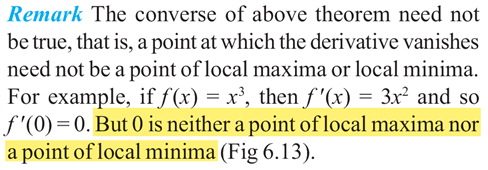
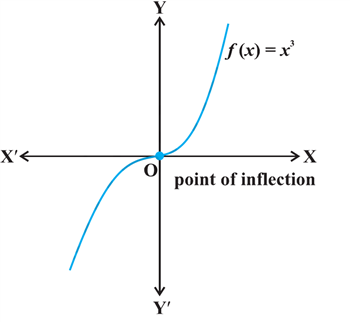
So x = 0 is a critical point. But \(f'(x) = 3x^2 \gt 0\) for every \(x \ne 0\): f' does not change sign at x = 0. By the first derivative test, x = 0 is neither a point of local maximum nor of local minimum.
The values agree: \(f(x) \lt 0 = f(0)\) for x < 0 and \(f(x) \gt 0 = f(0)\) for x > 0, so f(0) is neither the largest nor the smallest value near 0.
Since f is increasing on the whole of R, it has no maximum value at x = 1 either (f(2) = 8 > f(1) = 1).
Tip: \(f'(c) = 0\) does not by itself give an extreme value. \(x^3\) at x = 0 is the standard example where the derivative is zero but there is no maximum or minimum.
NCERT (2026-27 edition):
Maxima and Minima