
Read the given passage and answer the questions that follow:
Seed is often described as a fertilised ovule. Seeds are formed inside fruits. A seed typically consists of seed coat(s), cotyledon(s) and an embryonal axis. Mature seeds may be albuminous or non-albuminous.
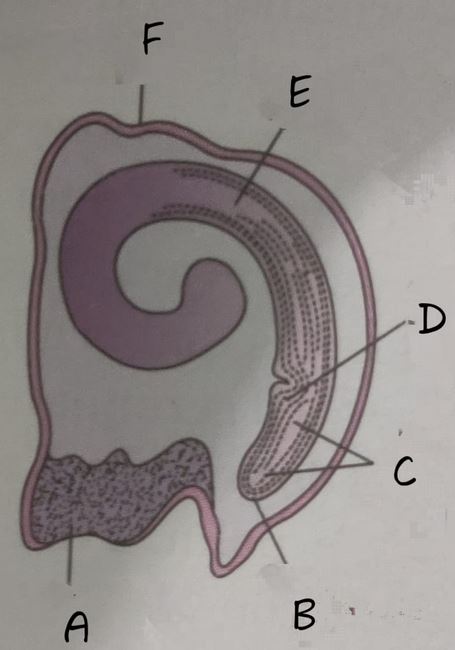
Label the given seed structure.
Answer & explanation
Correct answer: option 4
The correct answer is Option (4) → A - Endosperm
B - Root tip
C - Hypocotyl root axis
D - Shoot apical meristem
E - Cotyledon
F - Seed coat
The seed in the question is the curved albuminous seed drawn in Figure 1.15(a) of the book. Read the labels from the base: A is the dotted food tissue at the bottom, the endosperm. B points to the lowest end of the embryonal axis, the root tip. C marks the part of the axis just above it, the hypocotyl root axis. D is the shoot apical meristem, where the axis meets the cotyledon. E is the long curved cotyledon, and F is the outer covering, the seed coat.
Options (1), (2) and (3) give B as the hypocotyl root axis and C as the root tip, which turns the axis upside down. Options (2) and (3) also mix up the seed coat with the cotyledon or the endosperm. Only Option (4) gives all six labels correctly.
Note: Six labels in one question, and not one of them came from a paragraph. The seed drawings of Figure 1.15 earn their marks too, so give them the same time as the text beside them.
NCERT Extract:
Seed – “In angiosperms, the seed is the final product of sexual reproduction. It is often described as a fertilised ovule. Seeds are formed inside fruits. A seed typically consists of seed coat(s), cotyledon(s) and an embryo axis. The cotyledons (Figure 1.15a) of the embryo are simple structures, generally thick and swollen due to storage of food reserves (as in legumes).”
Embryo – “… The portion of embryonal axis above the level of cotyledons is the epicotyl, which terminates with the plumule or stem tip. The cylindrical portion below the level of cotyledons is hypocotyl that terminates at its lower end in the radicle or root tip. The root tip is covered with a root cap.”
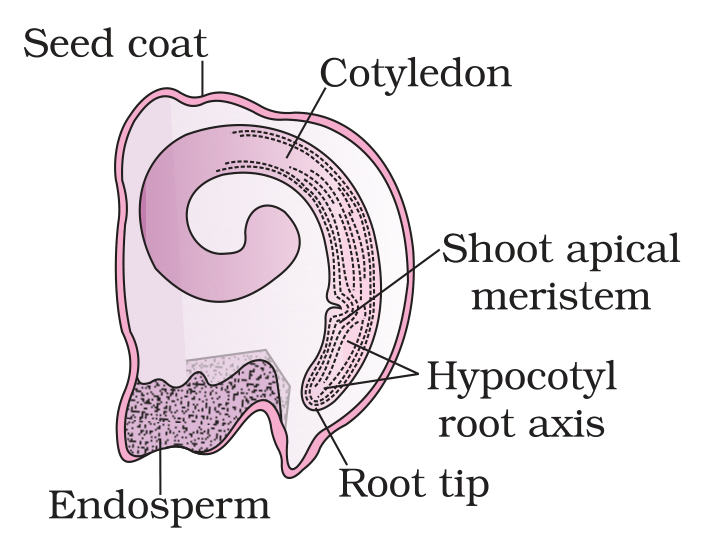
Figure 1.15 (a) Structure of some seeds