
In the following examples, select the primary alkyl halide
(A). 1-Bromo-3-methylbutane
(B). 2-Bromo-2-methylbutane
(C). 3-Bromo propene
(D). Chlorophenyl methane
Choose the correct answer from the options given below:
Answer & explanation
Correct answer: option 1
The correct answer is Option (1) → (A), (C) and (D) only
A halide is primary, secondary or tertiary according to the carbon that carries the halogen: a primary (1°) carbon is bonded to only one other carbon atom, a secondary carbon to two and a tertiary carbon to three. Allylic and benzylic halides are classified in the same way, by the sp3 carbon that carries the halogen.
(A) 1-Bromo-3-methylbutane, \( \ce{(CH3)2CH-CH2-CH2Br} \) — Correct. The bromine is on C-1, a \( \ce{CH2} \) bonded to only one carbon: a primary alkyl halide.
(B) 2-Bromo-2-methylbutane, \( \ce{CH3CH2C(CH3)2Br} \) — Incorrect. The bromine is on C-2, which is bonded to three carbons (C-1, C-3 and the methyl group): a tertiary halide.
(C) 3-Bromopropene, \( \ce{CH2=CH-CH2Br} \) (allyl bromide) — Correct. The bromine is on an sp3 \( \ce{CH2} \) next to the C=C bond, so it is an allylic halide, and that carbon is bonded to only one carbon: a primary allylic halide.
(D) Chlorophenylmethane, \( \ce{C6H5-CH2Cl} \) (benzyl chloride) — Correct. The chlorine is on an sp3 \( \ce{CH2} \) attached to the benzene ring, so it is a benzylic halide, and that carbon is bonded to one carbon of the ring only: a primary benzylic halide.
NCERT (2026-27 edition):
Alkyl Halides or Haloalkanes
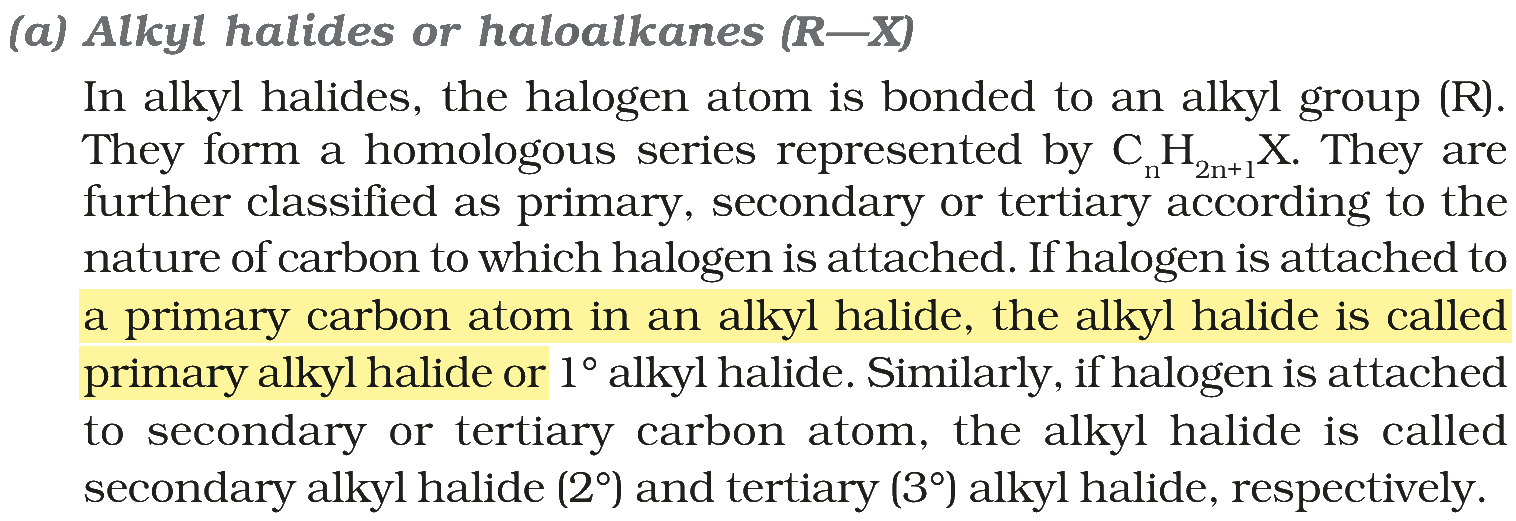
Allylic Halides – “These are the compounds in which the halogen atom is bonded to an sp3-hybridised carbon atom adjacent to carbon-carbon double bond (C=C) i.e. to an allylic carbon.”
Benzylic Halides – “These are the compounds in which the halogen atom is bonded to an sp3-hybridised carbon atom attached to an aromatic ring.”