Consider the following ions:
(A) Fe3+ (B) Sc3+ (C) Cu2+ (D) Cr3+
Which set contains all the coloured ions among them, and no colourless ion?
Answer & explanation
Correct answer: option 4
The correct answer is Option (4) → (A), (C) and (D) only
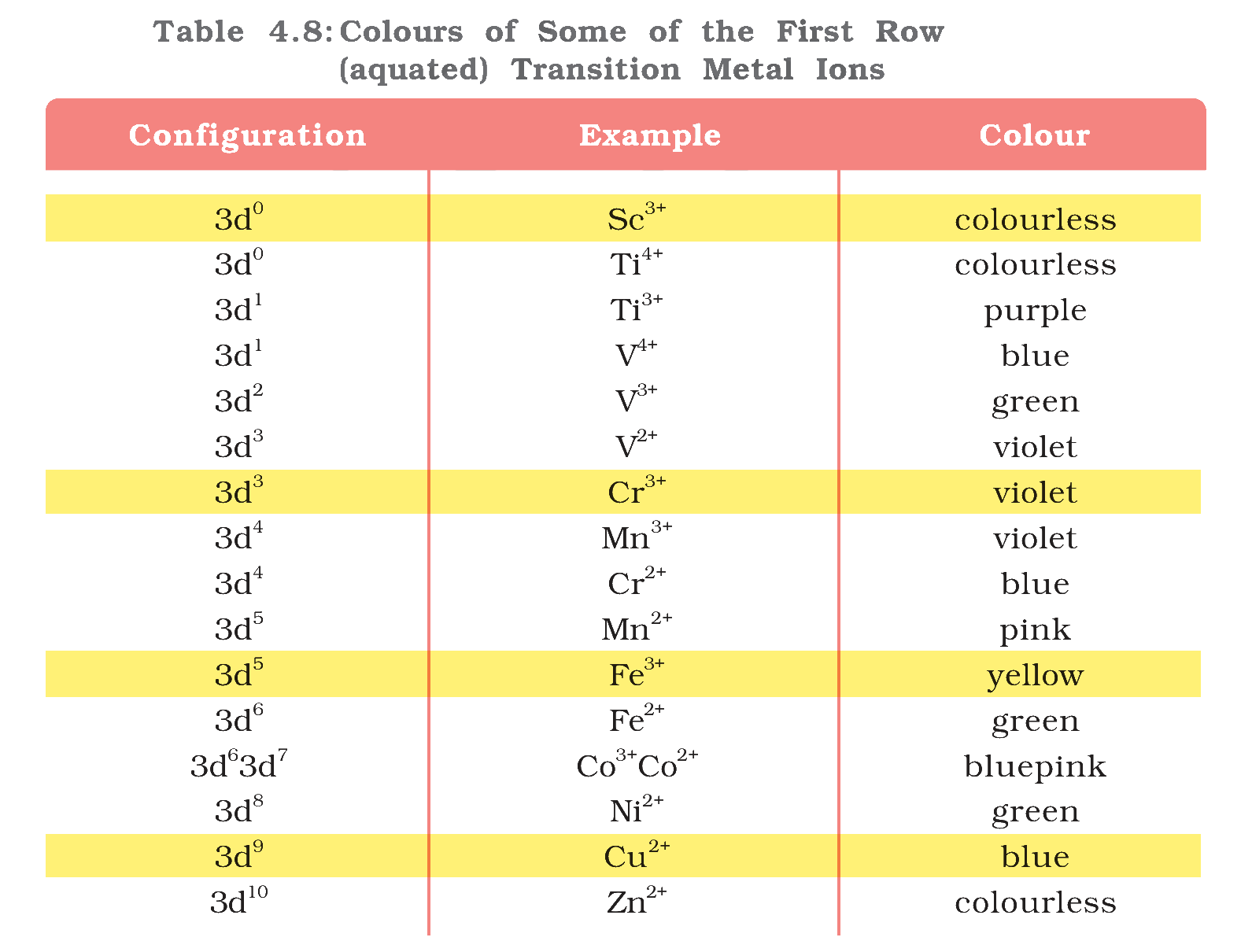
A transition metal ion is coloured when an electron can be excited from a lower energy d orbital to a higher energy d orbital by absorbing visible light. This needs a partly filled d subshell; an ion with 3d0 or 3d10 is colourless.
(A) Fe3+: Fe (Z = 26) is [Ar]3d64s2; losing the two 4s electrons and one 3d electron gives 3d5. Coloured (yellow).
(B) Sc3+: Sc (Z = 21) is [Ar]3d14s2; losing all three outer electrons gives 3d0. No d electron to excite: colourless.
(C) Cu2+: Cu (Z = 29) is [Ar]3d104s1; losing the 4s electron and one 3d electron gives 3d9. Coloured (blue).
(D) Cr3+: Cr (Z = 24) is [Ar]3d54s1; losing the 4s electron and two 3d electrons gives 3d3. Coloured (violet).
NCERT (2026-27 edition):
4.3.10 Formation of Coloured Ions – “When an electron from a lower energy d orbital is excited to a higher energy d orbital, the energy of excitation corresponds to the frequency of light absorbed (Unit 5). This frequency generally lies in the visible region. The colour observed corresponds to the complementary colour of the light absorbed. … In aqueous solutions where water molecules are the ligands, the colours of the ions observed are listed in Table 4.8.”
Table 4.8: Colours of Some of the First Row (aquated) Transition Metal Ions