The correct statements about collision theory of reaction rates are
(A) The proper orientation of reactant molecules leads to bond formation
(B) In kinetic theory of gases, the reactant molecules are assumed to be soft spheres.
(C) The number of collisions per second per unit volume of the reaction mixture is known as Collision frequency (Z)
(D) In collision theory, activation energy and proper orientation of the molecules together determine the criteria for an effective collision.
Choose the correct answer from the options given below:
Answer & explanation
Correct answer: option 3
The correct answer is Option (3) → (A), (C) and (D) only
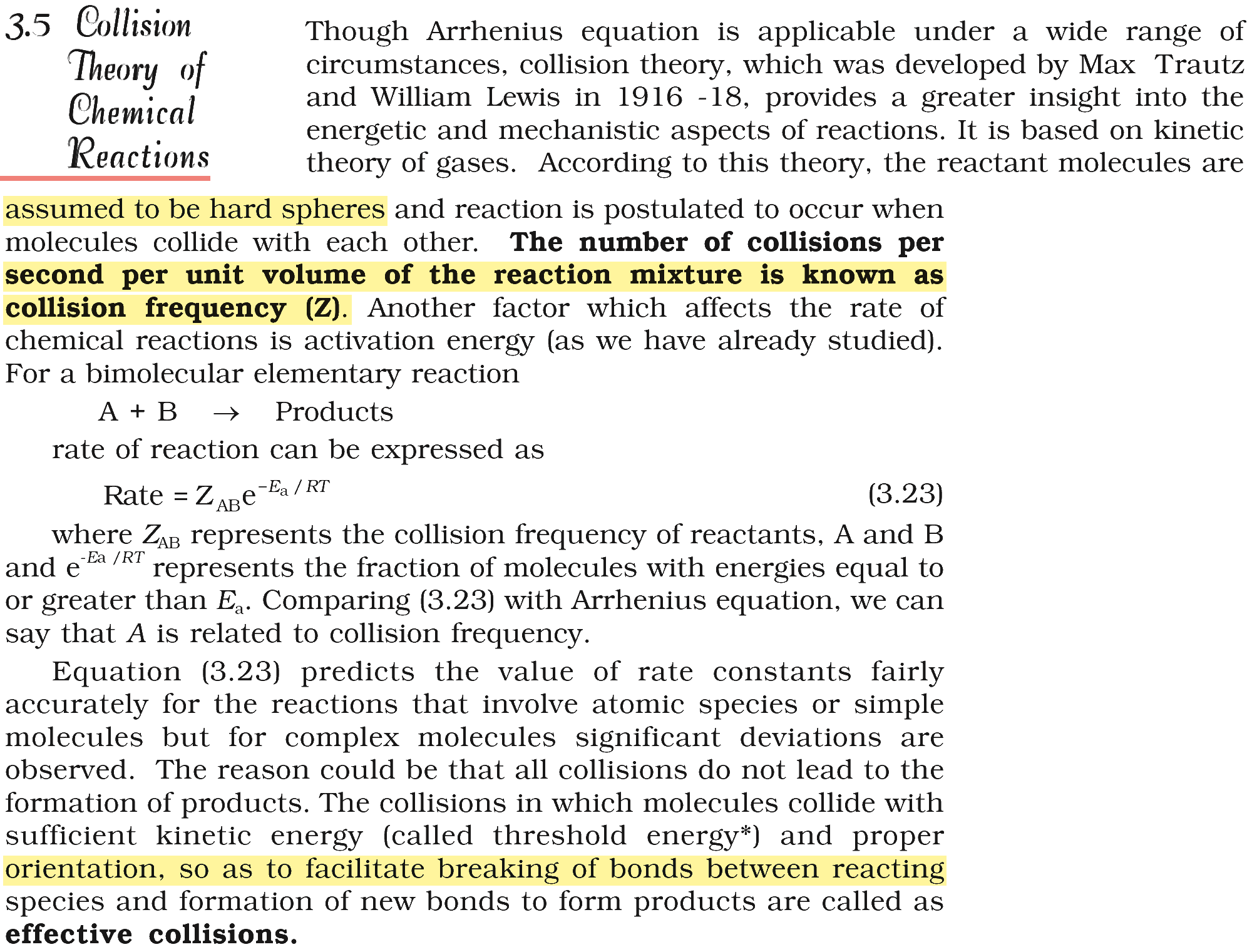
The collision theory treats reactant molecules as hard spheres and says that a reaction takes place only when molecules collide. Not every collision works: an effective collision needs two things together:
enough energy, at least the threshold energy (activation energy), and
the proper orientation of the colliding molecules.
The rate is written with the collision frequency ZAB, the energy factor and the probability (steric) factor P for orientation:
\( \displaystyle \text{Rate}=P\,Z_{AB}\,e^{-E_a/RT} \)
Judging each statement:
(A) The proper orientation of reactant molecules leads to bond formation — Correct. For example, \( \ce{CH3Br} \) gives \( \ce{CH3OH} \) only when \( \ce{OH^{-}} \) strikes the carbon from the side opposite to Br; other orientations just bounce back.
(B) In kinetic theory of gases, the reactant molecules are assumed to be soft spheres. — Incorrect. Collision theory, based on the kinetic theory of gases, assumes the molecules to be hard spheres.
(C) The number of collisions per second per unit volume of the reaction mixture is known as Collision frequency (Z) — Correct. This is the definition of collision frequency.
(D) In collision theory, activation energy and proper orientation of the molecules together determine the criteria for an effective collision. — Correct. Both conditions must be met at the same time.
NCERT (2026-27 edition):
Collision Theory of Chemical Reactions