Given below are two statements:
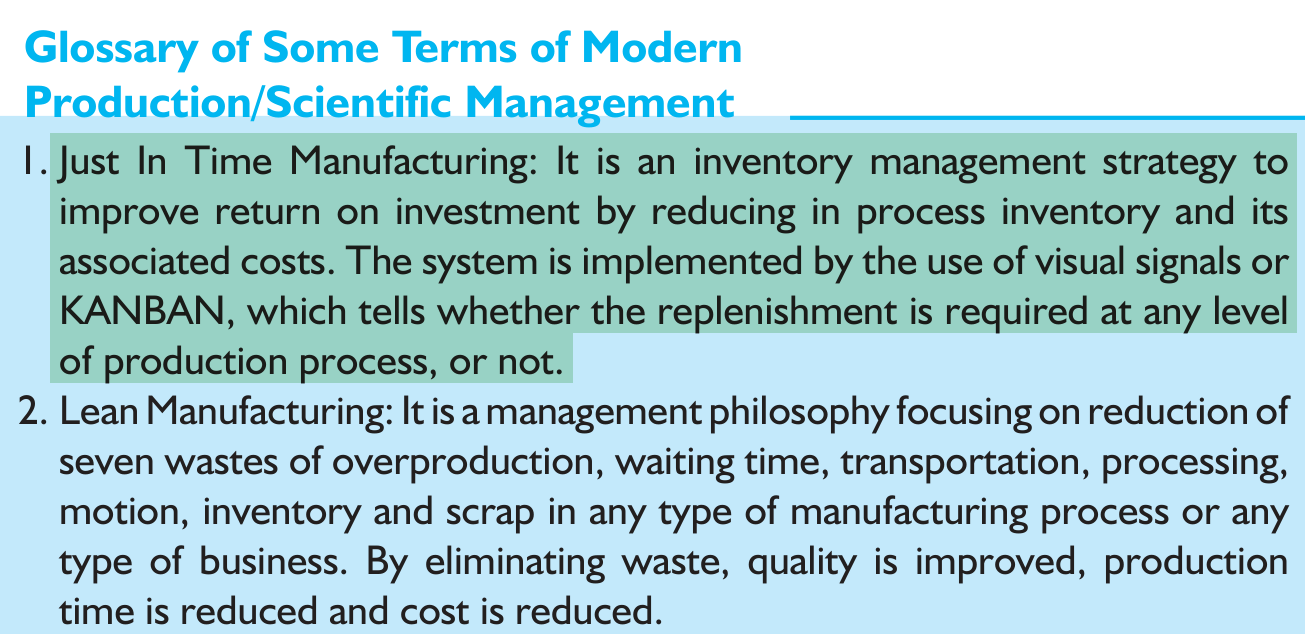
Statement I: Just In Time manufacturing is an inventory management strategy to improve return on investment by reducing in-process inventory and its associated costs.
Statement II: Lean Manufacturing is implemented by the use of visual signals or KANBAN, which tell whether replenishment is required at any level of the production process.
In the light of the above statements, choose the correct answer from the options given below:
Answer & explanation
Correct answer: option 3
The correct answer is Option (3) → Statement I is correct but Statement II is incorrect.
Statement I: Just In Time manufacturing is an inventory management strategy to improve return on investment by reducing in-process inventory and its associated costs. — Correct. JIT keeps only the stock needed at each stage. With less in-process inventory, holding costs fall and return on investment rises.
Statement II: Lean Manufacturing is implemented by the use of visual signals or KANBAN, which tell whether replenishment is required at any level of the production process. — Incorrect. KANBAN signals are how Just In Time manufacturing is put into practice, not Lean Manufacturing. Lean Manufacturing is a philosophy of cutting seven wastes, such as overproduction, waiting time, motion and scrap.
NCERT (2026-27 Edition):
|