Read the following information carefully and answer the next five questions.
G, K and B were partners running a partnership for last 10 years, sharing profit and loss in the ratio of 5:3:2. Post Covid, their firm was affected badly and started incurring losses. On 31st March,2023 they all decided to dissolve the firm due to continuous losses. Their capital balances were ₹4,00,000, ₹3,00,000 and ₹2,00,000 respectively. Firm had liabilities ₹80,000, cash balance ₹40,000, other sundry assets ₹8,50,000 and P&L A/c constituted the rest. Assets realised at 80% and liabilities were paid in full. There was unrecorded liability of ₹50,000 which was settled at ₹40,000. Realisation expenses amounted to ₹30,000 being paid by G on behalf of the firm.
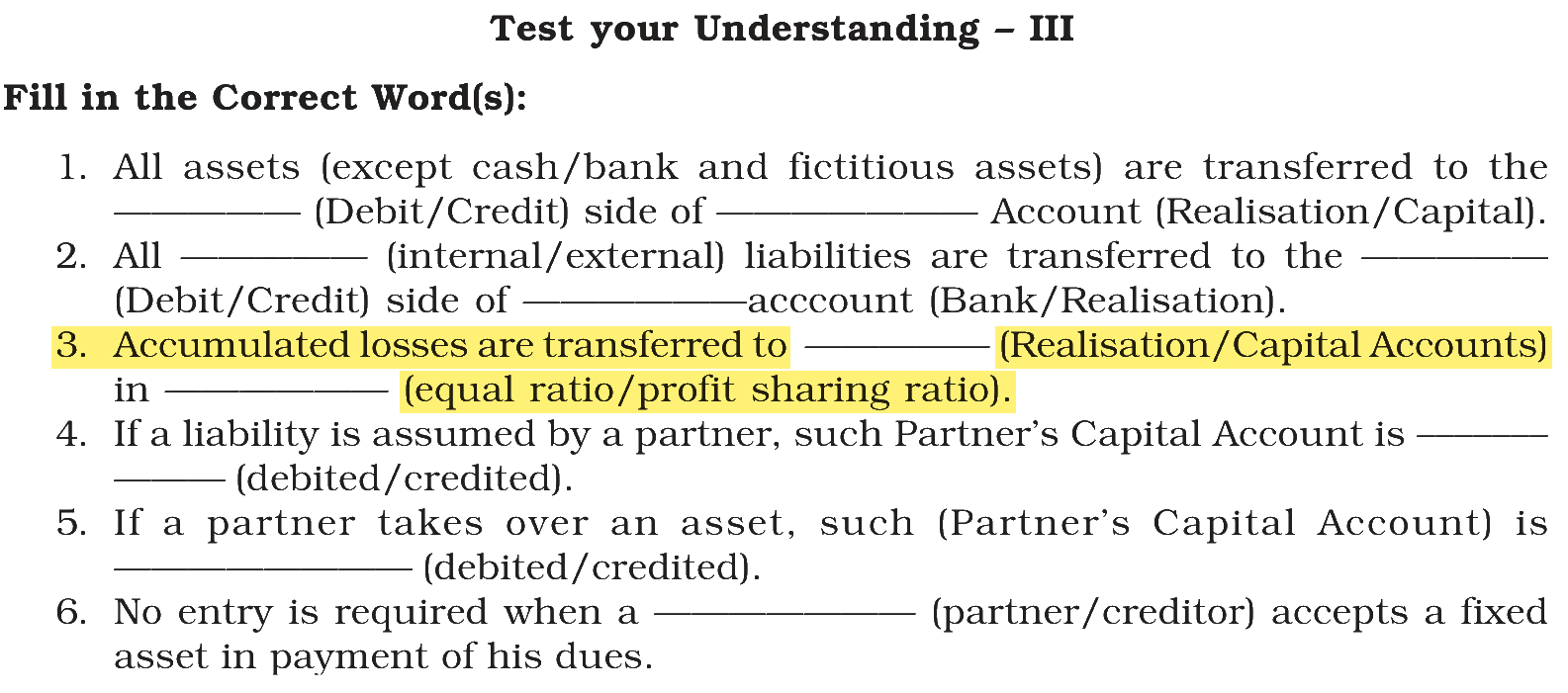
Existing profit or loss Account in the books of the firm will be shared/borne by partners in the ratio:
Answer & explanation
Correct answer: option 1
The correct answer is Option (1) → 5:3:2
The debit balance of the Profit and Loss Account is a loss of past years that the partners have not yet borne. Past profits and losses are shared in the profit sharing ratio agreed among the partners, here 5:3:2, so on dissolution it is debited to their capital accounts in that ratio.
Why the other options are incorrect
Option (2) Equal ratio — Incorrect. Equal sharing applies only when there is no agreement; here the partners have agreed on 5:3:2.
Option (3) 4:3:2 — Incorrect. This is the ratio of their capitals (₹4,00,000 : ₹3,00,000 : ₹2,00,000), which does not decide the sharing of profit or loss.
Option (4) Ratio of closing capital claims — Incorrect. Capital ratios are used only for a capital deficiency of an insolvent partner (Garner vs. Murray), not for an accumulated loss.
NCERT (2026-27 edition):
NCERT (2026-27 edition):
NCERT (2026-27 edition):
|