CUETMOCK
  • Pricing
  • Mentors
Log inStart freeStart free mocks→

First test, then trust

Try a free CUET mock test.

Join 5,00,000+ students who rehearsed exam day on the exact NTA screen before sitting CUET. On the web and on Android.

Start free mocks →Get the Android app
CUETMOCK

India's #1 CUET Mock Test Platform. Original NCERT-based questions on the exact NTA exam screen — trusted by 5,00,000+ students since CUET 2022.

Get it onGoogle PlayScan to download the CUETMOCK app

Mock tests

  • CUET mock test series
  • Browse all papers
  • Commerce mocks
  • Humanities (Arts) mocks
  • Science mocks
  • Languages & GAT mocks
  • Free practice questions
  • Pricing

Resources

  • CUET exam guide
  • CUET syllabus
  • Universities accepting CUET
  • Expert blogs
  • News & notifications
  • Webinars & counselling
  • CUET score calculator
  • How we estimate your rank
  • FAQs

Company

  • About us
  • Our leadership & team
  • Our toppers
  • Mentors
  • For schools
  • Contact us
  • Terms
  • Privacy
  • Refund policy

Talk to us

+91 7696 6630 56info@cuetmock.comWhatsApp us

Our other platforms

  • JEE Mock — For IIT-JEE aspirants
  • NEET Mock — For NEET aspirants

Newsletter

Exam updates, study material and offers — no spam.

© 2026 NYC Ventures Pvt. Ltd.

701-702, Royal Business Park, Zirakpur, Punjab - 140603

  • Terms of use
  • Privacy policy
  • Refund policy
  • Contact us

iCUETMOCK is an independent preparation platform, not affiliated with the National Testing Agency (NTA). Always check exam details on the official NTA website.

  • Home
  • Mock tests
  • CUET guide
  • Pricing
  • Log in
Home/Practice questions/Political Science
Political ScienceContemporary World Politics: Contemporary Centres of power

ASEAN’s secondary objective was:

Read the passage and answer the question:

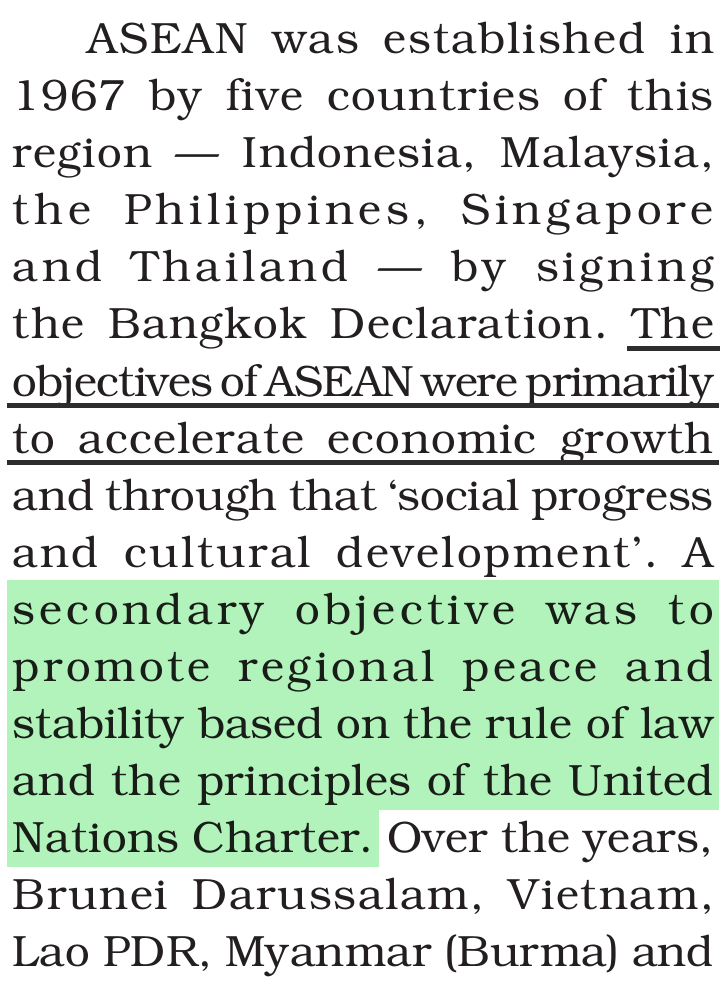
ASEAN was established in 1967 by 5 countries of this region: Indonesia, Malaysia, Philippines, Singapore, and Thailand, by signing The Bangkok Declaration. The objectives of ASEAN were primarily to accelerate economic growth, and through that social progress and cultural development, the secondary objective was to promote regional peace and stability based on the rule of law and principles of the United Nations Charter. Over the years, Brunei Darussalam, Vietnam, Lao PDR, Myanmar and Cambodia joined ASEAN taking its strength to 10.

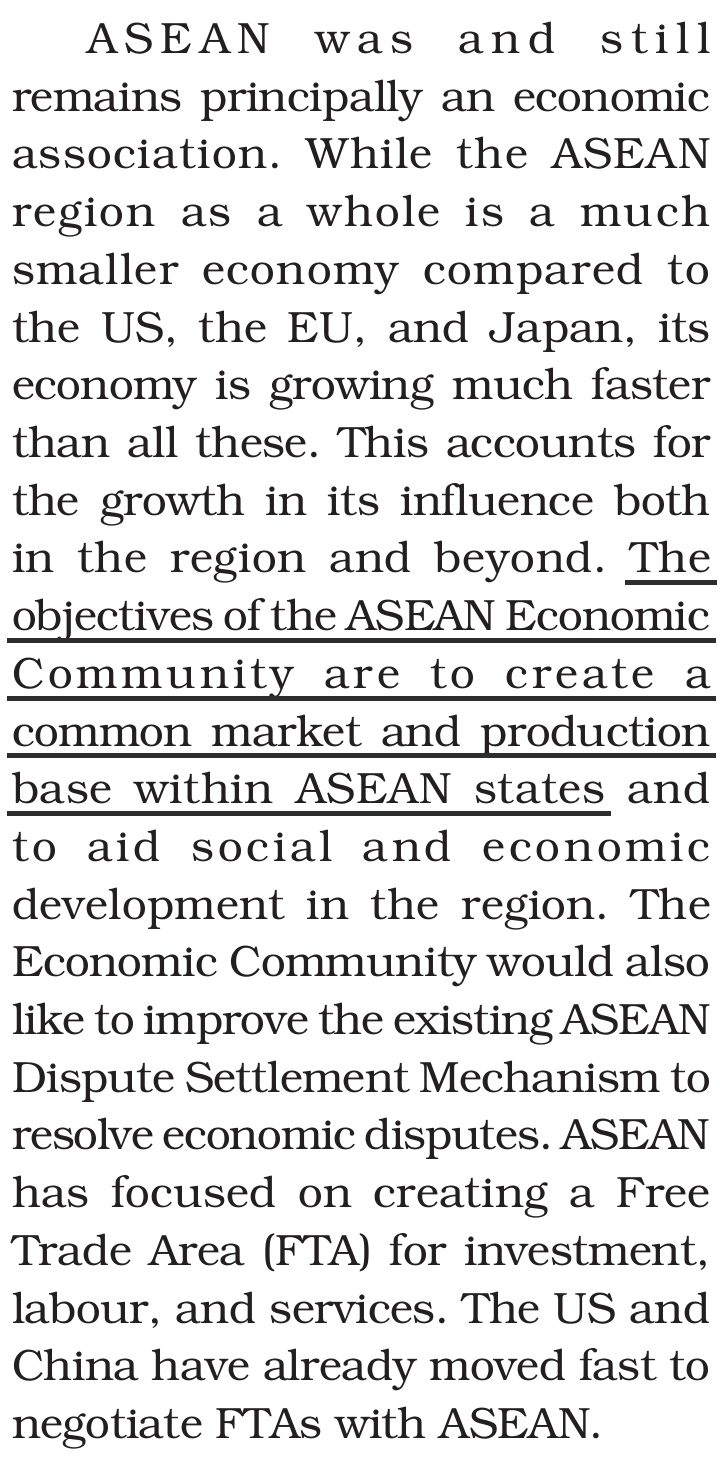
ASEAN had several agreements in place by which member states promised to uphold Peace, Neutrality, Cooperation, Non-Interference and respect for National differences and Sovereign Rights. ASEAN Regional Forum (ARF) was established in 1994. ASEAN has focused on creating a Free Trade Area (FTA) for investment, labour, and services.

ASEAN’s secondary objective was:

Answer & explanation+

Correct answer: option 2

The correct answer is Option (2) → To promote regional peace and stability based on the rule of law and the principles of the United Nations Charter.

Option (1) To accelerate economic growth and through that social progress and cultural development. — Incorrect. The objectives of ASEAN were primarily to accelerate economic growth and through that social progress and cultural development: this is its primary objective.

Option (2) To promote regional peace and stability based on the rule of law and the principles of the United Nations Charter. — Correct. After economic growth, social progress and cultural development, a secondary objective was to promote regional peace and stability based on the rule of law and the principles of the United Nations Charter.

Option (3) To accelerate economic growth and Rule of Law of United Nations Charter. — Incorrect. It joins a piece of the primary objective (economic growth) to a piece of the secondary one (the rule of law), so it is neither of the two objectives as ASEAN set them.

Option (4) To create common Market and Production among ASEAN Countries. — Incorrect. A common market and production base within ASEAN states is an objective of the ASEAN Economic Community, one of the three pillars of the ASEAN Community agreed in 2003.


NCERT (2026-27): Contemporary World Politics — Chapter 2: Contemporary Centres of Power

NCERT extractNCERT extract

Advertisement

Practise more on Contemporary World Politics: Contemporary Centres of power

Chapter-wise mocks on the real NTA exam screen, with solutions and your rank. Your first mocks are free.

Start free mocks →

Advertisement

Next questions

  1. When the quantity demanded of a commodity changes only because of a change in its own price, it is called:Economics · Micro Economics: Theory of Consumer behaviour
  2. The sum of money that will give Rs.3 as interest per day at the rate of 5% per annum at simple interest is:General Aptitude Test · Numerical Ability
  3. Three circles of radius 7 cm are kept touching each other. The string is tightly tied around these three circles. What is the length of the…General Aptitude Test · Quantitative Reasoning
  4. Select the option figure which contains figure X embedded in it as its part. (Rotation is not allowed)General Aptitude Test · Verbal Reasoning
  5. Select the correct order of the format of an informal letter from the options given below: (A) Salutation(B) Body of the letter(C) Sender's…English · Formal/Informal Letters
  6. Arrange the following stages of development of a dicot embryo in the order of their occurrence:(A) Formation of heart-shaped embryo(B) Form…Biology · Sexual Reproduction in Flowering Plants
  7. Farley's assistant didn't want him to linger at the entrance of the laboratory as -English · Comprehension - (Narrative / Factual)
  8. Given below are two statements: one is labelled as Assertion (A) and the other is labelled as Reason (R). Assertion (A): Controlling provid…Business Studies · Controlling
  9. Direction : A word is Represented by only one set of numbers as given in any of the alternatives. The sets of numbers given in the alternat…General Aptitude Test · Verbal Reasoning
  10. Which one of the following south Indian states has the highest groundwater utilisation (in per cent) of its total ground water potential?Geography · India-People and Economy: Water resources