
The graph showing number of decayed nuclei verses time t is :
Answer & explanation
Correct answer: option 3
The correct answer is Option (3)
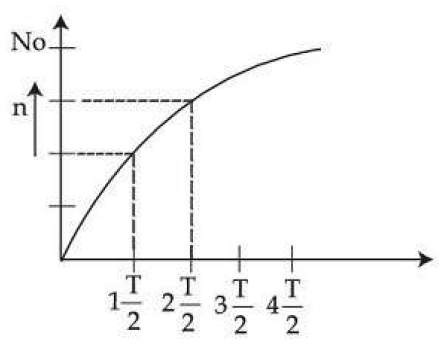
By the law of radioactive decay, the number of nuclei left undecayed after time \( t \) is \( N = N_0 e^{-\lambda t} \). The number that have decayed is the rest:
\( \displaystyle n = N_0 - N = N_0\left(1 - e^{-\lambda t}\right) \)
So \( n \) starts at zero at \( t = 0 \), rises quickly at first and then more slowly, and approaches \( N_0 \) without crossing it. After each half-life \( T_{1/2} \) half of the remaining nuclei decay:
\( t = T_{1/2}: \; n = N_0/2 \)
\( t = 2T_{1/2}: \; n = 3N_0/4 \)
The graph of Option (3) starts at the origin, passes through \( N_0/2 \) at \( T_{1/2} \) and \( 3N_0/4 \) at \( 2T_{1/2} \), and levels off towards \( N_0 \).
Why the other options are incorrect
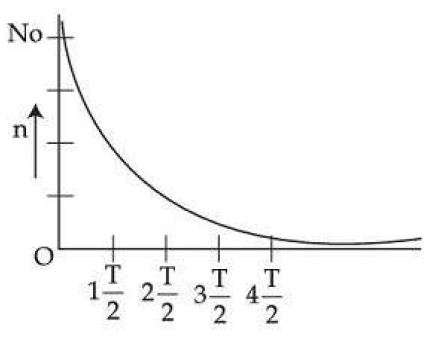
Option (1) — Incorrect. This falling curve is the number of nuclei still undecayed, \( N = N_0 e^{-\lambda t} \), not the number decayed.
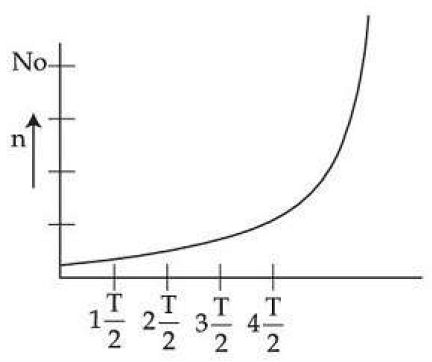
Option (2) — Incorrect. This curve starts above zero and rises ever faster past \( N_0 \); the number decayed can never exceed \( N_0 \) and its rate of increase falls with time.
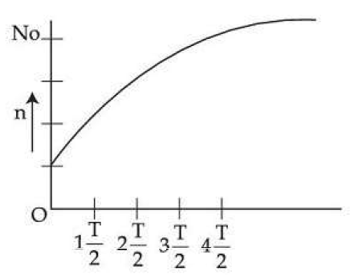
Option (4) — Incorrect. The curve starts at about \( N_0/4 \) at \( t = 0 \), but no nuclei have decayed at the start, so it must begin at the origin.
Note: This question is from the pre-rationalised NCERT book (2022-23). The topic was removed from the latest NCERT book (2026-27), and it also appears to be out of the CUET 2026 syllabus.
NCERT (Pre-rationalised edition, 2022-23):
Law of Radioactive Decay – “… Setting t0 = 0 and rearranging Eq. (13.12) gives us
\( \displaystyle \ln\frac{N}{N_0} = -\lambda t \qquad (13.13) \)
which gives
\( \displaystyle N(t) = N_0\, e^{-\lambda t} \qquad (13.14) \)
… The decay of radionuclides follows quite a different law, the law of radioactive decay represented by Eq. (13.14).”