
The defect caused by the substitution of amino acids in the beta globin chain of the haemoglobin molecule is:
Answer & explanation
Correct answer: option 3
The correct answer is Option (3) → Sickle-cell anaemia
(1) Phenylketonuria — Incorrect. This is an inborn error of metabolism. The person lacks the enzyme that changes phenylalanine into tyrosine, so phenylalanine builds up. It is not a haemoglobin defect.
(2) Thalassemia — Incorrect. Here too the haemoglobin is affected, but the fault is in the amount. Too few globin molecules are made. Sickle-cell anaemia is a fault in the quality of the globin, because the molecule made is changed.
(3) Sickle-cell anaemia — Correct. A single base change in the gene (GAG to GUG at the sixth codon) puts valine in place of glutamic acid in the beta globin chain. At low oxygen the changed haemoglobin molecules join together (polymerise), and the red cell turns from a biconcave disc into a sickle shape.
(4) Haemophilia — Incorrect. This is an X-linked recessive disease in which blood does not clot properly. It is not caused by a change in the globin chain.
NCERT Extract:
Mendelian Disorders – “… The defect is caused by the substitution of Glutamic acid (Glu) by Valine (Val) at the sixth position of the beta globin chain of the haemoglobin molecule. The substitution of amino acid in the globin protein results due to the single base substitution at the sixth codon of the beta globin gene from GAG to GUG. The mutant haemoglobin molecule undergoes polymerisation under low oxygen tension causing the change in the shape of the RBC from biconcave disc to elongated sickle like structure (Figure 4.15).”
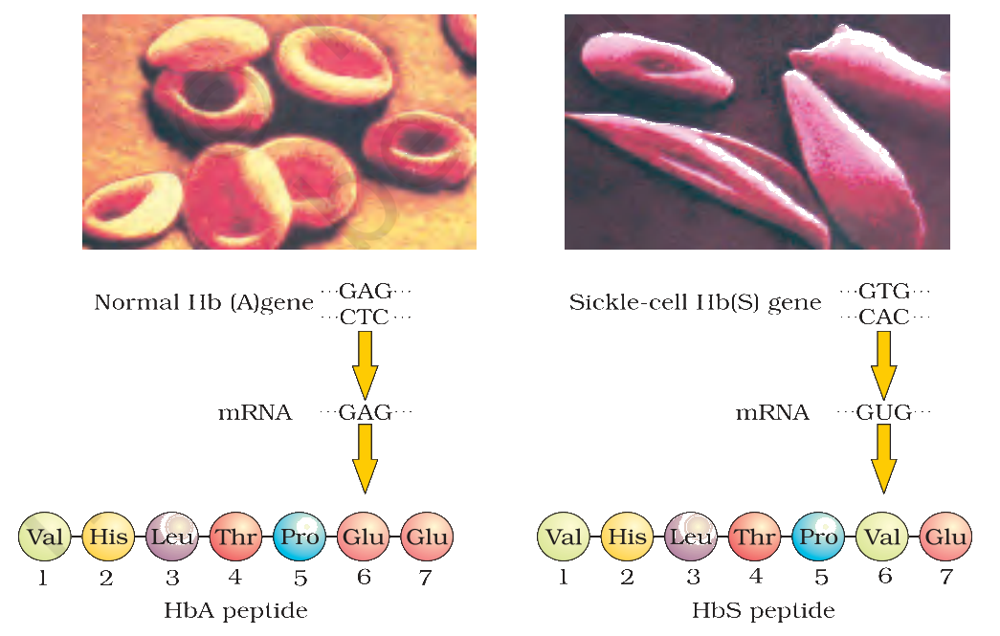
Figure 4.15 Micrograph of the red blood cells and the amino acid composition of the relevant portion of β-chain of haemoglobin: (a) From a normal individual; (b) From an individual with sickle-cell anaemia