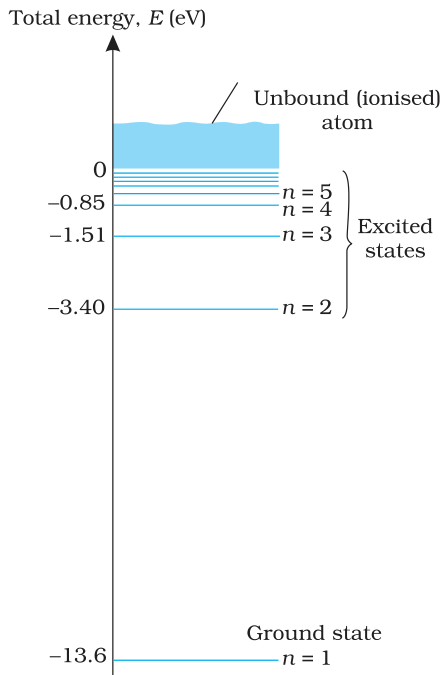
The highest energy state of the hydrogen atom, according to Bohr model, corresponds to the energy of
Answer & explanation
Correct answer: option 3
The correct answer is Option (3) → 0 eV
In the Bohr model, energy is measured from zero for an electron at rest far away from the nucleus (free). A bound electron must be given energy to free it, so every bound level has negative energy, which rises towards zero as n increases.
\( \displaystyle E_n = -\frac{13.6}{n^{2}}\,\mathrm{eV} \)
\( \displaystyle n \to \infty \Rightarrow E_n \to 0 \)
So the highest energy state (n → ∞) has energy 0 eV; there the electron is just free.
Why the other options are incorrect
Option (1) -13.6 eV — Incorrect. −13.6 eV is the ground state (n = 1), the lowest energy.
Option (2) +13.6 eV — Incorrect. +13.6 eV is the size of the ionisation energy; a bound state always has negative energy.
Option (4) 5.3 keV — Incorrect. 5.3 keV is not related to the energy levels of hydrogen.
NCERT (2026-27):
Energy Levels – “… The energy level diagram* for the stationary states of a hydrogen atom, computed from Eq. (12.10), is given in Fig. 12.7. … In this diagram, the highest energy state corresponds to \( n = \infty \) in Eq, (12.10) and has an energy of 0 eV. This is the energy of the atom when the electron is completely removed (\( r = \infty \)) from the nucleus and is at rest.”