
In the IUPAC system, aliphatic carboxylic acids are named by replacing the ending –e in the name of the corresponding alkane with –oic acid. In numbering the carbon chain, the carboxylic carbon is numbered one. For naming compounds containing more than one carboxyl group, the alkyl chain leaving carboxyl groups is numbered and the number of carboxyl groups is indicated by adding the multiplicative prefix, dicarboxylic acid, tricarboxylic acid, etc. to the name of parent alkyl chain. The positions of –COOH groups are indicated by the arabic numeral before the multiplicative prefix.
What is the IUPAC name of the given compound?
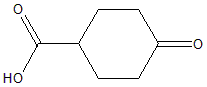
Answer & explanation
Correct answer: option 1
The correct answer is Option (1) → 4-Oxocyclohexane-1-carboxylic acid
The compound is a cyclohexane ring carrying a –COOH group on one carbon and a ketone C=O on the opposite carbon. The carboxylic acid is the principal group, so it gives the name ending and the ketone is written as a prefix.
Parent and ending: when –COOH is attached to a ring, the suffix –carboxylic acid is added to the full name of the ring: cyclohexane-1-carboxylic acid.
Numbering: the ring carbon that carries –COOH is C-1; counting round the ring, the carbonyl carbon is C-4.
Prefix: a ketone C=O named as a substituent is oxo, so the ring carries 4-oxo.
Name: 4-oxocyclohexane-1-carboxylic acid.
Why the other options are incorrect
Option (2) 4-Oxocyclohexane-1-carbaldehyde — Incorrect. The suffix carbaldehyde names a –CHO group on a ring; here the ring carries –COOH.
Option (3) 4-Hydroxycyclohexane-1-carboxylic acid — Incorrect. Hydroxy means an –OH group on the ring; here C-4 carries a C=O group.
Option (4) (4-Oxocyclohexyl)ethanoic acid — Incorrect. Ethanoic acid would need a –CH2– group between the ring and –COOH; here –COOH is bonded directly to the ring.