Read the passage carefully and answer the questions.
Many halogen containing organic compounds are present in nature and some of them are clinically useful. These classes of organic compounds find a wide range of applications in our daily life as well as in industries. Many of the polyhalogen compounds are useful too in agriculture. However, some of these compounds cannot be easily decomposed and are thus considered to be environmental hazards. These halo compounds are prepared via different synthetic routes where a variety of organic compounds can be used as substrates such as amines, hydrocarbons etc. They are used as solvents for relatively non-polar compounds. These compounds exhibit substitution and elimination reactions, in addition to their reactions with different metals, which leads to the formation of a versatile starting material for others organic compounds.
The reaction of aryl halide with sodium and dry ether is known as
Answer & explanation
Correct answer: option 1
The correct answer is Option (1) → Fittig Reaction
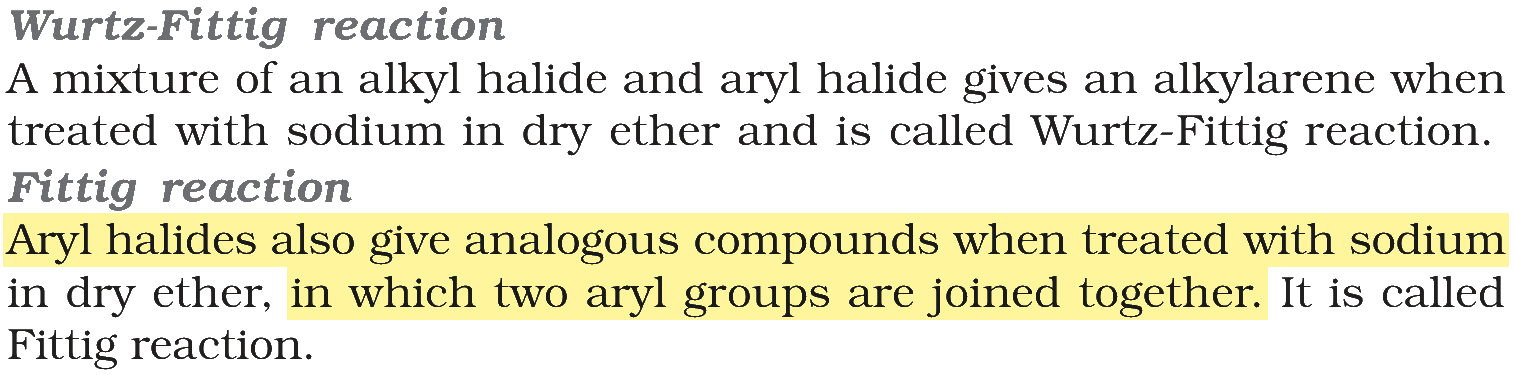
Sodium in dry ether removes halogen atoms from organic halides as sodium halide and joins the two organic groups left behind. The name tells what is joined: two alkyl groups in the Wurtz reaction, an alkyl and an aryl group in the Wurtz-Fittig reaction, and two aryl groups in the Fittig reaction.
When an aryl halide alone is treated with sodium in dry ether, two aryl groups join to give a diaryl. Chlorobenzene, for example, gives biphenyl:
\( \displaystyle \ce{2C6H5Cl + 2Na} \xrightarrow{\text{dry ether}} \ce{C6H5-C6H5 + 2NaCl} \)
So the reaction of an aryl halide with sodium and dry ether is the Fittig reaction.
Why the other options are incorrect
Option (2) Wurtz-Fittig reaction — Incorrect. It needs a mixture of an alkyl halide and an aryl halide, and gives an alkylarene:
\( \displaystyle \ce{C6H5Cl + 2Na + CH3Cl} \xrightarrow{\text{dry ether}} \ce{C6H5-CH3 + 2NaCl} \)
Option (3) Wurtz reaction — Incorrect. It joins two alkyl halides and gives an alkane with twice the number of carbon atoms:
\( \displaystyle \ce{2CH3Br + 2Na} \xrightarrow{\text{dry ether}} \ce{CH3-CH3 + 2NaBr} \)
Option (4) Sandmeyer’s reaction — Incorrect. It starts from a benzenediazonium salt, not an aryl halide, and uses a copper(I) salt to replace the diazonium group by Cl, Br or CN; no sodium is involved:
\( \displaystyle \ce{C6H5N2+Cl^-} \xrightarrow{\ce{Cu2Cl2}/\ce{HCl}} \ce{C6H5Cl + N2} \)
NCERT (2026-27 edition):
Wurtz-Fittig Reaction