
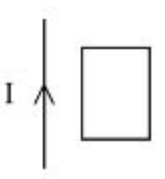
A rectangular closed loop is placed near a long current I carrying wire, as shown in figure.
A. If I is increased, induced current in loop is anticlockwise
B. If I is increased, the wire will repel the loop.
C. If loop is moved away from the wire induced current in the loop is anticlockwise
D. If loop is moved away from the wire, wire will attract the loop.
Choose the correct answer from the options given below:
Answer & explanation
Correct answer: option 4
The correct answer is Option (4) → A, B and D only
The current in the wire is upward and the loop is to its right, so by the right-hand rule the field of the wire at the loop points into the page. Its strength falls with distance from the wire. By Lenz's law the induced current opposes the change in flux, and the force on the loop opposes the change that causes it.
(A) If I is increased, induced current in loop is anticlockwise — Correct. The flux into the page grows, so the induced current makes a field out of the page inside the loop, which needs an anticlockwise current.
(B) If I is increased, the wire will repel the loop. — Correct. With the anticlockwise current, the near side of the loop carries current downward, opposite to the wire's current, so it is repelled more strongly than the far side is attracted.
(C) If loop is moved away from the wire induced current in the loop is anticlockwise — Incorrect. Moving away, the loop enters a weaker field, so the flux into the page decreases. The induced current must add flux into the page, so it is clockwise.
(D) If loop is moved away from the wire, wire will attract the loop. — Correct. With the clockwise current the near side carries current upward, parallel to the wire's current, so it is attracted more strongly than the far side is repelled.
NCERT (2026-27):
Lenz’s Law and Conservation of Energy – “… The statement of the law is: The polarity of induced emf is such that it tends to produce a current which opposes the change in magnetic flux that produced it. … This would result in an attractive force which opposes the motion of the magnet and the corresponding decrease in flux. … In this situation, the bar magnet experiences a repulsive force due to the induced current.”