
Answer & explanation
Correct answer: option 4
The correct answer is Option (4) → B, C, D only
The focal length of a thin lens follows from the lens maker's formula.
\( \displaystyle \frac{1}{f} = \left(\frac{\mu_{\mathrm{lens}}}{\mu_{\mathrm{medium}}} - 1\right)\left(\frac{1}{R_1} - \frac{1}{R_2}\right) \)
For an equi-convex lens in air (\( R_1 = R, R_2 = -R \)):
\( \displaystyle \frac{1}{f} = (\mu - 1)\,\frac{2}{R} = \frac{1}{20\,\mathrm{cm}} \)
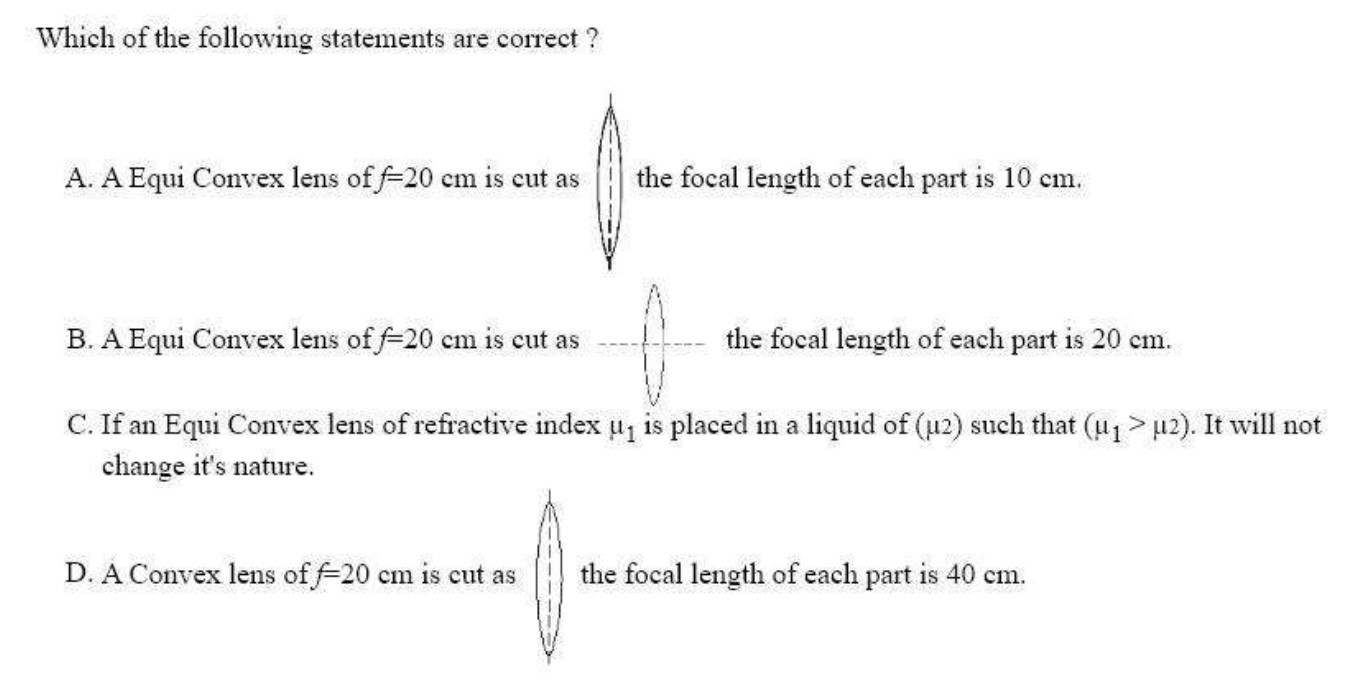
(A) Equi-convex lens of \( f = 20\,\mathrm{cm} \) cut by the plane perpendicular to the principal axis, as drawn; each part has focal length 10 cm. — Incorrect. Each half is a plano-convex lens with one curved surface of radius \( R \) and one flat surface (\( R_2 = \infty \)).
\( \displaystyle \frac{1}{f'} = (\mu - 1)\,\frac{1}{R} = \frac{1}{2}\times\frac{1}{20\,\mathrm{cm}} \;\Rightarrow\; f' = 40\,\mathrm{cm} \)
So each part has focal length 40 cm, not 10 cm.
(B) Equi-convex lens of \( f = 20\,\mathrm{cm} \) cut along the principal axis, as drawn; each part has focal length 20 cm. — Correct. Each half keeps both curved surfaces and the same material, so the lens maker's formula gives the same focal length, 20 cm.
(C) An equi-convex lens of refractive index \( \mu_1 \) placed in a liquid of refractive index \( \mu_2 \) with \( \mu_1 \gt \mu_2 \) does not change its nature. — Correct. The factor \( (\mu_1/\mu_2 - 1) \) is still positive, so the lens remains converging.
(D) Convex lens of \( f = 20\,\mathrm{cm} \) cut by the plane perpendicular to the principal axis, as drawn; each part has focal length 40 cm. — Correct. This is the same cut as in (A), so each part has focal length 40 cm.