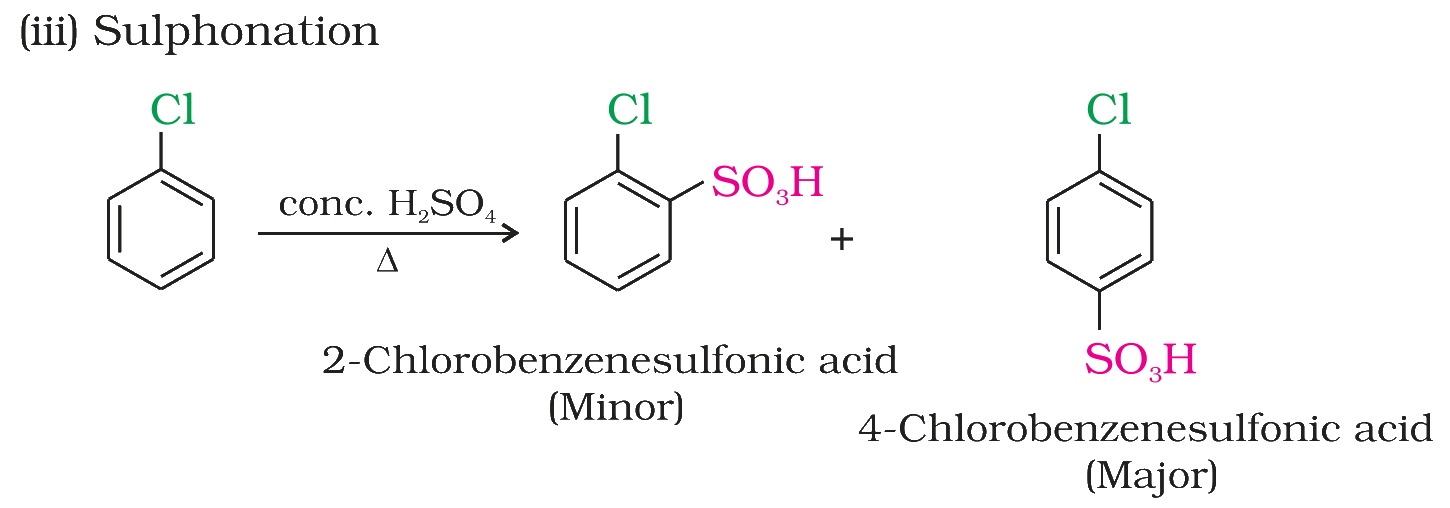
Sulphonation of chlorobenzene gives
Answer & explanation
Correct answer: option 4
The correct answer is Option (4) → o- and p-Chlorobenzenesulphonic acids
Sulphonation is an electrophilic substitution: an –SO3H group replaces a ring hydrogen.
In chlorobenzene the chlorine atom is slightly deactivating but ortho, para-directing, because its resonance raises the electron density more at the ortho and para positions than at the meta positions. Heating chlorobenzene with concentrated sulphuric acid therefore gives both isomers:
\( \displaystyle \ce{C6H5Cl + H2SO4} \xrightarrow[\Delta]{\text{conc.}} \ce{ClC6H4SO3H + H2O} \)
The –SO3H group enters ortho or para to chlorine: the para isomer is the major product and the ortho isomer the minor one.
Why the other options are incorrect
Option (1) m-Chlorobenzenesulphonic acid — Incorrect. Chlorine directs to ortho and para; the meta position is not favoured, since resonance does not raise its electron density.
Option (2) Benzenesulphonic acid — Incorrect. This would need the chlorine itself to be replaced. In sulphonation a ring hydrogen is replaced and the C–Cl bond stays.
Option (3) o-Chlorobenzenesulphonic acid only — Incorrect. The ortho isomer is only the minor product; the para isomer is formed as well, and in larger amount.
NCERT (2026-27 edition):
2. Electrophilic substitution reactions – “Haloarenes undergo the usual electrophilic reactions of the benzene ring such as halogenation, nitration, sulphonation and Friedel-Crafts reactions. Halogen atom besides being slightly deactivating is o, p- directing; therefore, further substitution occurs at ortho- and para- positions with respect to the halogen atom.”
6.7.2 Reactions of Haloarenes – “Due to resonance, the electron density increases more at ortho- and para-positions than at meta-positions.”