
Find the equivalent capacitance between the points A and B.
Answer & explanation
Correct answer: option 1
The correct answer is Option (1) → \( 4\,\mu\mathrm{F} \)
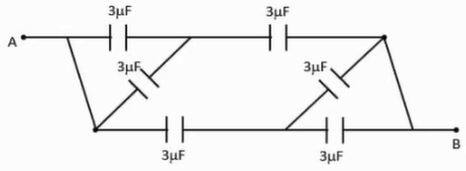
First find which plates are at the same potential. The slanting wire on the left joins the two left-hand junctions, so both are at the potential of A; the slanting wire on the right joins the two right-hand junctions, so both are at the potential of B. Call the middle junction of the upper row X and that of the lower row Y.
Two capacitors join A to X (the upper-left one and the left slanting one), so they are in parallel; X is joined to B by the upper-right capacitor alone, in series with that pair.
\( \displaystyle C_{AXB} = \frac{6 \times 3}{6 + 3}\,\mu\mathrm{F} = 2\,\mu\mathrm{F} \)
The lower-left capacitor alone joins A to Y; two capacitors join Y to B (the lower-right one and the right slanting one), in parallel.
\( \displaystyle C_{AYB} = \frac{3 \times 6}{3 + 6}\,\mu\mathrm{F} = 2\,\mu\mathrm{F} \)
These two paths both run from A to B, so they are in parallel.
\( \displaystyle C_{AB} = 2\,\mu\mathrm{F} + 2\,\mu\mathrm{F} = 4\,\mu\mathrm{F} \)