
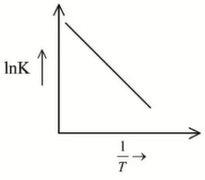
The plot of Ink and 1/T is given in the figure what is its slope?
Answer & explanation
Correct answer: option 1
The correct answer is option 1. \(-\frac{E_a}{R}\).
The Arrhenius equation describes the temperature dependence of reaction rates. It states that the rate constant (\(k\)) of a reaction is exponentially related to the inverse of the temperature (\(T\)):
\(k = Ae^{-\frac{E_a}{RT}} \)
Where:
\( A \) is the pre-exponential factor, which represents the frequency of collisions between reactant molecules.
\( E_a \) is the activation energy, which represents the minimum energy required for a reaction to occur.
\( R \) is the gas constant.
\( T \) is the absolute temperature in Kelvin.
Taking the natural logarithm of both sides of the equation, we get:
\( \ln(k) = \ln(A) - \frac{E_a}{RT} \)
This equation has the form of a straight line equation, \(y = mx + c\), where:
\( y = \ln(k) \),
\( m = -\frac{E_a}{R} \),
\( x = \frac{1}{T} \), and
\( c = \ln(A) \).
So, when we plot \(\ln(k)\) against \(\frac{1}{T}\), we should get a straight line with slope \(m = -\frac{E_a}{R}\). This slope represents the ratio of activation energy to the gas constant (\(R\)).
Hence, the correct option is: 1. \(-\frac{E_a}{R}\)
This relationship is fundamental in understanding how temperature affects reaction rates and is often used in kinetics studies to determine activation energies.