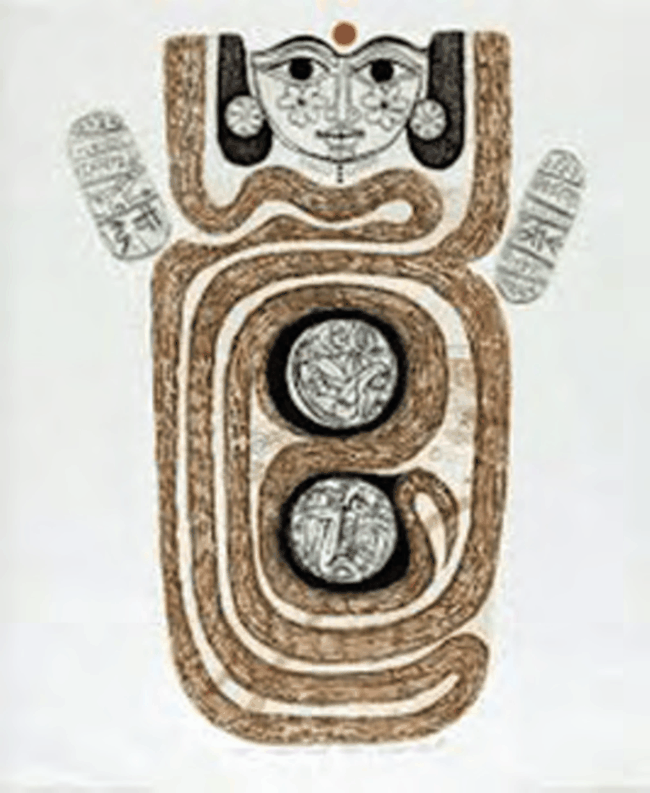
Observe the print by Jyoti Bhatt shown below and read the passage about it.
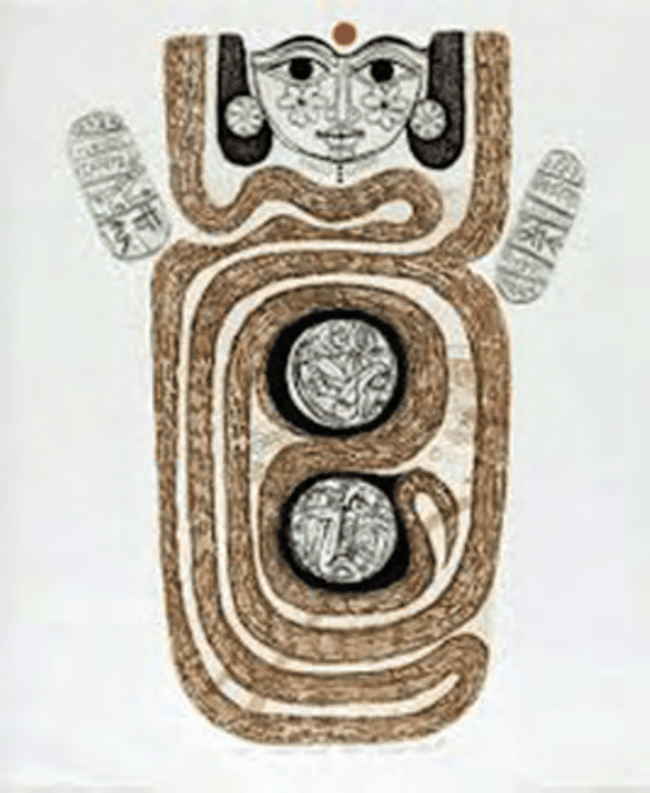
Jyoti Bhatt carved out an art language based on folk traditions and popular practices. He brings together many visual elements into a composite narrative. In this print, the pictorial image of Devi is re-cast and re-contextualised with a linear drawing of the frontal face of a woman, folk motifs and patterns.
How is the portrait of Devi placed in this print?
Answer & explanation
Correct answer: option 3
The correct answer is Option (3) → Centrally, as an iconic image
Option (1) To one side, as part of a narrative — Incorrect. The composite narrative describes Bhatt’s art language as a whole. The Devi herself is not pushed to one side.
Option (2) In the background, as a decorative motif — Incorrect. The folk motifs and patterns sit around the portrait. The Devi is the main image, not a background motif.
Option (3) Centrally, as an iconic image — Correct. The portrait of Devi is centrally placed as an iconic image.
Option (4) Repeated several times, as a folk pattern — Incorrect. The folk motifs and patterns sit around the portrait. The Devi is shown once, as the central image.
Note: This topic was not named in the CUET 2026 syllabus, but it was part of the NCERT chapter. In 2025 and 2026, NTA also asked questions on topics in NCERT that the CUET syllabus did not name. So our mocks have questions from every part of the NCERT chapter, to give you enough practice. Read the whole chapter, not only the sub-topics named in the syllabus.
NCERT (2026-27): “Devi This is an etching on paper made by Jyoti Bhatt (1934) in 1970. … In this print, pictorial image of Devi is re-cast and re-contextualised with a linear drawing of the frontal face of a woman, folk motifs and patterns. The portrait of Devi is centrally placed as an iconic image. The two-dimensionality of words and motifs around the portrait expresses the Tantric philosophy, evoking the power of self-evolution and self-involution, seeing reality as the intertwining dynamic and static principle of Shakti.”
|