
Match List-I with List-II
|
List-I (Reaction Name) |
List-II (Reaction) |
|
(A) Rosenmund Reaction |
(I) |
|
(B) Stephen Reaction |
(II) \( \ce{C6H6 + CO} \xrightarrow{\ce{HCl},\ \text{anhyd. }\ce{AlCl3/CuCl}} \ce{C6H5CHO} \) |
|
(C) Gattermann Koch Reaction |
(III) |
|
(D) Etard Reaction |
(IV) \( \ce{C6H5CH3} \xrightarrow[\text{(ii) }\ce{H3O+}]{\text{(i) }\ce{CrO2Cl2},\ \ce{CS2}} \ce{C6H5CHO} \) |

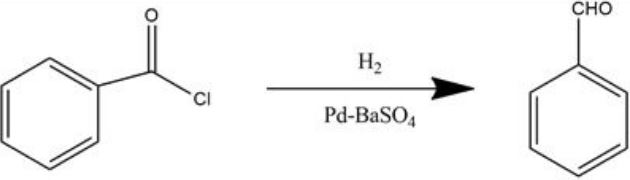
Choose the correct answer from the options given below:
Answer & explanation
Correct answer: option 4
The correct answer is Option (4) → (A)-(III), (B)-(I), (C)-(II), (D)-(IV)
All four named reactions prepare aldehydes, each from a different starting material:
From acyl chlorides: hydrogenation over palladium on barium sulphate (Rosenmund reduction).
From nitriles: stannous chloride and HCl give an imine, which is hydrolysed (Stephen reaction).
From arenes: carbon monoxide and HCl with anhydrous \( \ce{AlCl3} \) or CuCl (Gattermann-Koch reaction), or, for methylbenzene, chromyl chloride (Etard reaction).
(A) Rosenmund Reaction — This matches (III), benzoyl chloride with \( \ce{H2} \) over Pd-\( \ce{BaSO4} \). The barium sulphate partly poisons the catalyst, so the reduction stops at the aldehyde.
\( \displaystyle \ce{C6H5COCl + H2} \xrightarrow{\ce{Pd-BaSO4}} \ce{C6H5CHO + HCl} \)
(B) Stephen Reaction — This matches (I), the nitrile with \( \ce{SnCl2} \) and HCl followed by hydrolysis.
\( \displaystyle \ce{C6H5CN} \xrightarrow{\ce{SnCl2 + HCl}} \ce{C6H5CH=NH} \xrightarrow{\ce{H3O^+}} \ce{C6H5CHO} \)
(C) Gattermann Koch Reaction — This matches (II), the formylation of benzene with carbon monoxide and HCl.
\( \displaystyle \ce{C6H6 + CO} \xrightarrow{\ce{HCl},\ \text{anhyd. }\ce{AlCl3}/\ce{CuCl}} \ce{C6H5CHO} \)
(D) Etard Reaction — This matches (IV), oxidation with chromyl chloride in \( \ce{CS2} \). Chromyl chloride oxidises the methyl group of methylbenzene to a chromium complex, which water hydrolyses to benzaldehyde.
\( \displaystyle \ce{C6H5CH3 + CrO2Cl2} \xrightarrow{\ce{CS2}} \text{chromium complex} \xrightarrow{\ce{H3O^+}} \ce{C6H5CHO} \)
Shortcut: Rosenmund needs the acid chloride, so (A)-(III), which is found only in Option (4).