
Which of the following circuits can not be used to measure the resistance of resistor R?
Answer & explanation
Correct answer: option 2
The correct answer is Option (2)
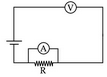
The resistance is found from Ohm's law, \( R = V/I \). For this the ammeter must be in series with R (so that it carries the current through R) and the voltmeter must be in parallel with R (so that it reads the potential difference across R).
In the circuit of Option (2) the meters are the other way round. The ammeter is connected in parallel with R; having almost zero resistance, it short-circuits R, so almost no current passes through R. The voltmeter is in series with the cell; its very high resistance allows almost no current in the circuit, and it reads nearly the emf of the cell, not the potential difference across R. Neither reading gives \( V \) or \( I \) for R, so this circuit cannot measure R.