
CUETMOCK
  • Pricing
  • Mentors
Log inStart freeStart free mocks→

First test, then trust

Try a free CUET mock test.

Join 5,00,000+ students who rehearsed exam day on the exact NTA screen before sitting CUET. On the web and on Android.

Start free mocks →Get the Android app
CUETMOCK

India's #1 CUET Mock Test Platform. Original NCERT-based questions on the exact NTA exam screen — trusted by 5,00,000+ students since CUET 2022.

Get it onGoogle PlayScan to download the CUETMOCK app

Mock tests

  • CUET mock test series
  • Browse all papers
  • Commerce mocks
  • Humanities (Arts) mocks
  • Science mocks
  • Languages & GAT mocks
  • Free practice questions
  • Pricing

Resources

  • CUET exam guide
  • CUET syllabus
  • Universities accepting CUET
  • Expert blogs
  • News & notifications
  • Webinars & counselling
  • CUET score calculator
  • How we estimate your rank
  • FAQs

Company

  • About us
  • Our leadership & team
  • Our toppers
  • Mentors
  • For schools
  • Contact us
  • Terms
  • Privacy
  • Refund policy

Talk to us

+91 7696 6630 56info@cuetmock.comWhatsApp us

Our other platforms

  • JEE Mock — For IIT-JEE aspirants
  • NEET Mock — For NEET aspirants

Newsletter

Exam updates, study material and offers — no spam.

© 2026 NYC Ventures Pvt. Ltd.

701-702, Royal Business Park, Zirakpur, Punjab - 140603

  • Terms of use
  • Privacy policy
  • Refund policy
  • Contact us

iCUETMOCK is an independent preparation platform, not affiliated with the National Testing Agency (NTA). Always check exam details on the official NTA website.

  • Home
  • Mock tests
  • CUET guide
  • Pricing
  • Log in
Home/Practice questions/Chemistry
ChemistryOrganic: Haloalkanes and Haloarenes

1-Chloro-4-nitro-benzene reacts with NaOH at 443K to form
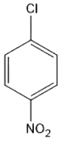
1-Chloro-4-nitro-benzene reacts with NaOH at 443K to form

Figure for Q18

Answer & explanation+

Correct answer: option 1

The correct answer is Option (1) → 4-nitrophenol

Aryl halides are very unreactive towards nucleophilic substitution. The C–Cl bond has partial double bond character from resonance with the ring and the carbon is sp2 hybridised, so the bond is hard to break. Chlorobenzene itself needs drastic conditions:

    \( \displaystyle \ce{C6H5Cl} \xrightarrow[\text{(ii) }\ce{H+}]{\text{(i) NaOH, 623 K, 300 atm}} \ce{C6H5OH} \)

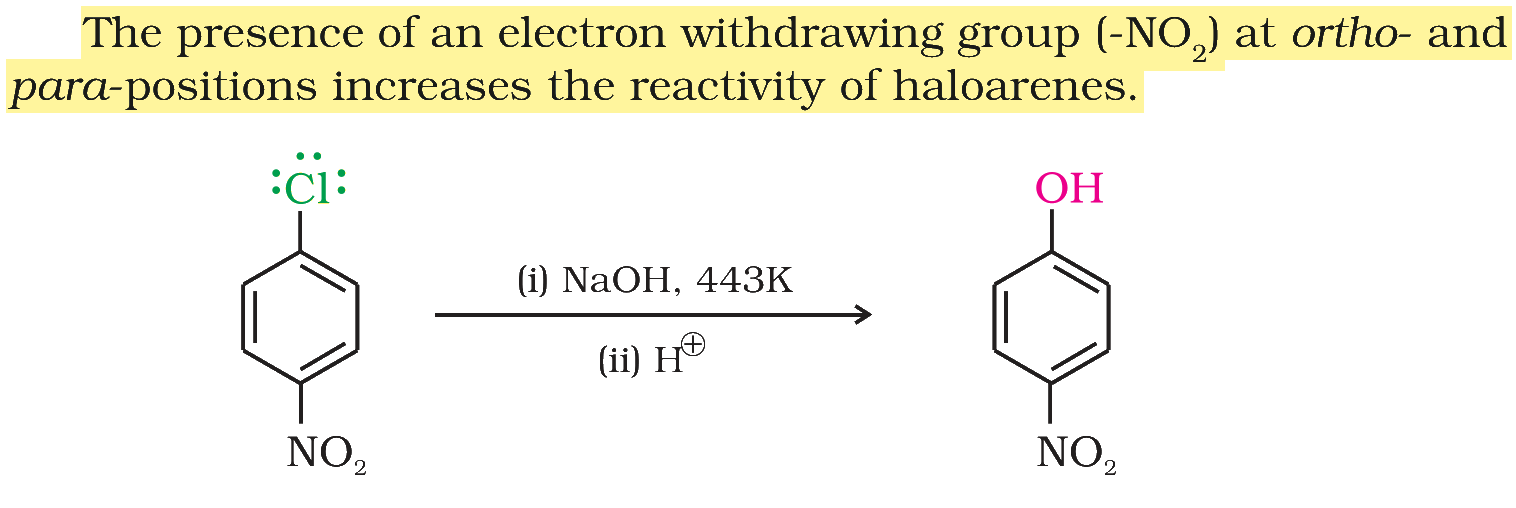
An electron withdrawing –NO2 group at the ortho or para position makes the reaction much easier. It pulls electron density out of the ring, helping the attack of \( \ce{OH^{-}} \), and it stabilises the negatively charged intermediate by resonance. The more nitro groups at these positions, the milder the conditions: 443 K for one, 368 K for two, and only warm water for three.

In 1-chloro-4-nitrobenzene the nitro group is para to Cl, so \( \ce{OH^{-}} \) replaces Cl at 443 K. The sodium phenoxide formed is then acidified:

    \( \displaystyle p\text{-}\ce{O2NC6H4Cl + 2NaOH} \xrightarrow{443\ \text{K}} p\text{-}\ce{O2NC6H4O^-Na+ + NaCl + H2O} \)

    \( \displaystyle p\text{-}\ce{O2NC6H4O^-Na+ + H+ -> }\,p\text{-}\ce{O2NC6H4OH + Na+} \)

Only the chlorine is replaced; the nitro group stays where it was. The product is 4-nitrophenol.

Why the other options are incorrect

  • Option (2) 4-chlorophenol — Incorrect. Here the nitro group has been replaced and the chlorine kept. In this reaction the halogen is the group that leaves; the –\( \ce{NO2} \) group is what activates the ring.

  • Option (3) 2-chloro-5-nitrophenol — Incorrect. This would need an –OH group to replace a ring hydrogen next to Cl. Hydroxide ion does not displace hydrogen; it replaces the halogen.

  • Option (4) 2-chlorophenol — Incorrect. This has lost the nitro group and gained an –OH at a ring carbon that carried hydrogen; neither change takes place.

NCERT (2026-27 edition):
Replacement by Hydroxyl Group – …
Textbook extract

Advertisement

Practise more on Organic: Haloalkanes and Haloarenes

Chapter-wise mocks on the real NTA exam screen, with solutions and your rank. Your first mocks are free.

Start free mocks →

Advertisement

Next questions

  1. Assertion: Goitre is more common in people living in mountainous regions. Reasoning: The food of people in mountains lacks in iodine.General Aptitude Test · Verbal Reasoning
  2. Slightly more females than males live in most countries. Which statements about this are correct?(A) Girl babies resist disease in infancy…Sociology · Indian Society: Demographic Structure of Indian Society
  3. Which of the following is not a significant characteristic of a pulse?Physics · Communication
  4. Select the INCORRECTLY spelt word.English · Spelling Check
  5. Select the option that is related to the fifth term in the same way as the second term is related to the first term and the fourth term is…General Aptitude Test · General Ability
  6. Which of the following statements is true about the First Gulf war? A. The First Gulf war revealed the vast technological gap that had open…Political Science · Contemporary World Politics: US Hegemony in World Politics
  7. Until the 1980s, more than 80 per cent of the people in China were dependent on farming as their sole source of livelihood. Since then, the…Economics · Indian Economic Development: Comparative Development Experiences of India and its Neighbours
  8. If A is an invertible matrix, then which of the following statement(s) is/are TRUE? (A) |A^-1| = |A| (B) (A^-1)^-1 = A (C) A^-1 =(adj A)/(|…Maths. Section A · Determinants
  9. After the implementation of Integrated Tribal Development Project (ITDP) in the Bharmaur region, which traditional activity of the Gaddis s…Geography · India-People and Economy: Planning and Sustainable development in Indian Context
  10. What is a necessary condition for osmosis to take place?Chemistry · Physical: Solutions