
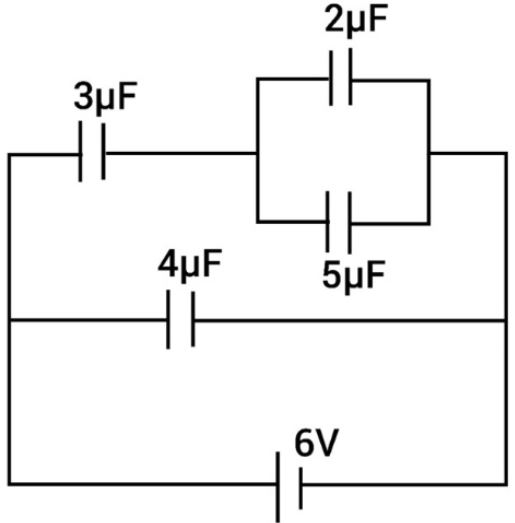
In the circuit shown, the charge (in \( \mu\mathrm{C} \)) on the \( 5\,\mu\mathrm{F} \) capacitor is
Answer & explanation
Correct answer: option 3
The correct answer is Option (3) → 9
Capacitors in parallel have the same voltage and their capacitances add; capacitors in series carry the same charge.
From the figure, the \( 4\,\mu\mathrm{F} \) capacitor is joined directly across the 6 V cell, so it does not change the voltage on the other branch.
That branch is the \( 3\,\mu\mathrm{F} \) capacitor in series with the parallel pair of \( 2\,\mu\mathrm{F} \) and \( 5\,\mu\mathrm{F} \). It also has 6 V across it.
The parallel pair is equivalent to:
\( \begin{aligned} C_p &= 2\,\mu\mathrm{F}+5\,\mu\mathrm{F} \\ &= 7\,\mu\mathrm{F} \end{aligned} \)
In series with the \( 3\,\mu\mathrm{F} \) capacitor, the branch capacitance is:
\( \begin{aligned} C_s &= \frac{3\times7}{3+7}\,\mu\mathrm{F} \\ &= 2.1\,\mu\mathrm{F} \end{aligned} \)
The charge on the branch, which is also the charge on the parallel pair, is:
\( \begin{aligned} Q &= C_sV \\ &= 2.1\,\mu\mathrm{F}\times6\,\mathrm{V} \\ &= 12.6\,\mu\mathrm{C} \end{aligned} \)
The voltage across the parallel pair is:
\( \begin{aligned} V_p &= \frac{Q}{C_p} \\ &= \frac{12.6\,\mu\mathrm{C}}{7\,\mu\mathrm{F}} \\ &= 1.8\,\mathrm{V} \end{aligned} \)
Therefore, the charge on the \( 5\,\mu\mathrm{F} \) capacitor is:
\( \begin{aligned} Q_5 &= 5\,\mu\mathrm{F}\times V_p \\ &= 5\,\mu\mathrm{F}\times1.8\,\mathrm{V} \\ &= 9\,\mu\mathrm{C} \end{aligned} \)