Arrange the following events in order of their occurrence in India.
A. Assam Labour and Emigration Bill helped tea planters
B. Tea Industry started in India
C. Joc Charnock set up a trading post by the River Hoogly
D. All India Muslim Ladies Conference was held and resolved to condemn polygamy
E. Raja Ram Mohan Roy launched an appeal to repeal Sati
Choose the correct answer from the options given below.
Answer & explanation
Correct answer: option 4
The correct answer is Option (4) → C, B, A, E, D
Note 1: The given answer is as per the official NTA Answer Key. However, none of the given options appears to be correct, as explained below.
C. Joc Charnock set up a trading post by the River Hoogly — 1690: the English merchant Job Charnock leased three villages by the river Hugli to set up a trading post, the beginning of Calcutta.
E. Raja Ram Mohan Roy launched an appeal to repeal Sati — a decade before he set up the Brahmo Samaj in 1828, that is, around 1818, Rammohun Roy undertook the campaign against sati.
B. Tea Industry started in India — the tea industry began in India in 1851.
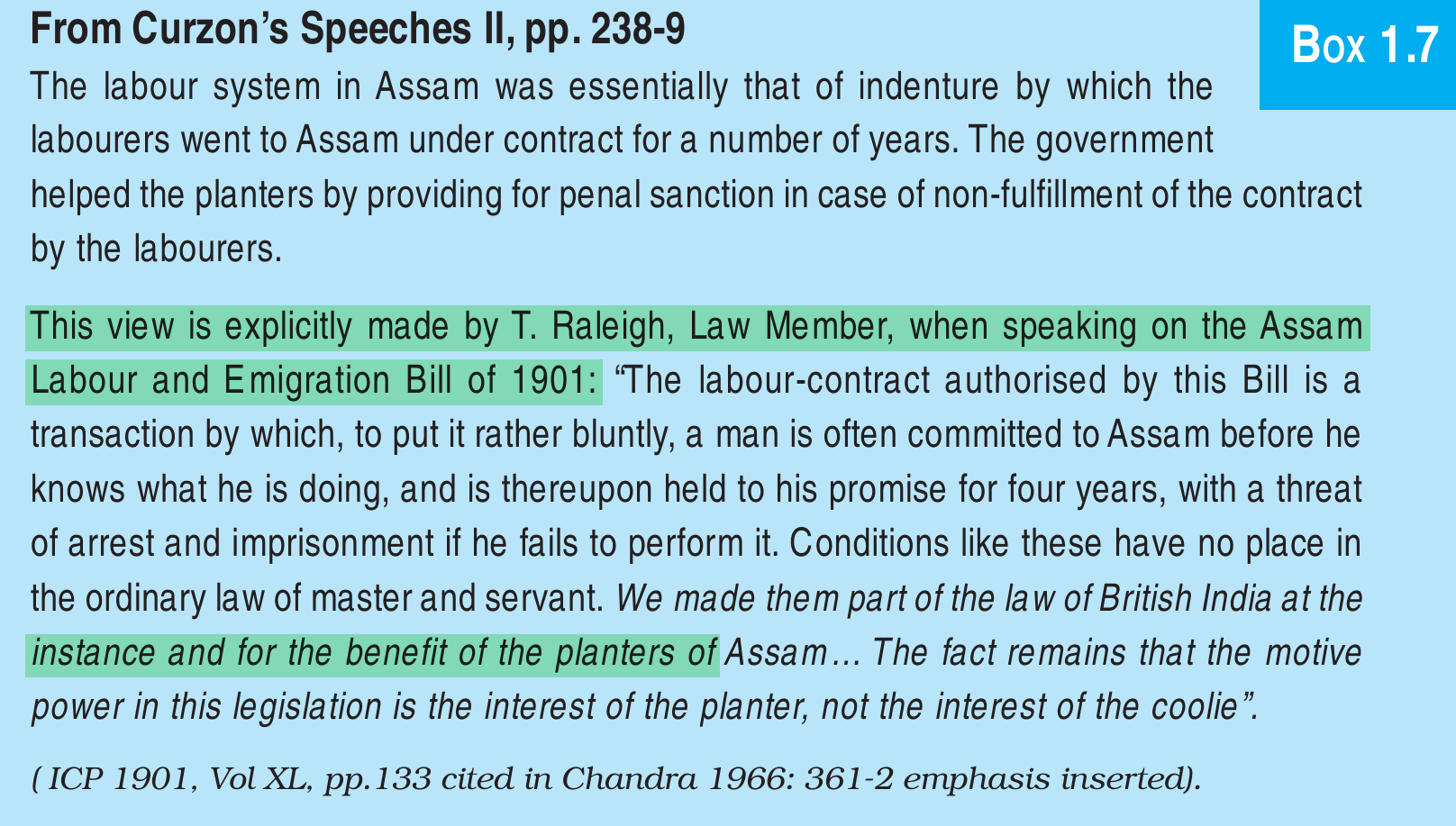
A. Assam Labour and Emigration Bill helped tea planters — the Law Member T. Raleigh spoke on the Assam Labour and Emigration Bill of 1901, admitting that its labour contract was made for the benefit of the planters of Assam.
D. All India Muslim Ladies Conference was held and resolved to condemn polygamy — the All-India Muslim Ladies Conference was founded in 1914. No date is given for the resolution against polygamy proposed by Jahanara Shah Nawaz at this conference; it can only have come after the conference was founded, so its place as the latest of the five events is reached by reasoning.
So the order of the dates is C, E, B, A, D, which no printed option gives. Option (4), ‘C, B, A, E, D’, marked by NTA, places Rammohun Roy’s campaign against sati (around 1818) after the Assam Labour and Emigration Bill of 1901.
Note 2: The Assam Labour and Emigration Bill of 1901 was in Box 1.7 of the chapter ‘Structural Change’ in the pre-rationalised NCERT, which NTA followed in 2023. This box has been deleted from the NCERT book (2025-26), though the chapter is still there.
NCERT (2025-26): “In 1690, an English merchant named Job Charnock arranged to lease three villages (named Kolikata, Gobindapur, and Sutanuti) by the river Hugli in order to set up a trading post. In 1698, Fort William was established by the river for defensive purposes, and a large open area was cleared around the fort for military engagements. The fort and the open area (called Maidan) formed the core of the city that emerged rather rapidly.” “…Raja Rammohun Roy’s attempts to reform society, religion and the status of women can be taken as the starting point of nineteenth century social reform in Bengal. A decade before establishing the Brahmo Samaj in 1828, Roy undertook the campaign against ‘sati’ which was the first women’s issue to receive public attention.…” “…Modern social organisations like the Brahmo Samaj in Bengal and Arya Samaj in Punjab were set up. The All-India Muslim Ladies Conference (AnjumanE-Khawatn-E-Islam) was founded in 1914.…” “Likewise Muslim social reformers actively debated the meaning of polygamy and purdah. For example, a resolution against the evils of polygamy was proposed by Jahanara Shah Nawas at the All India Muslim Ladies Conference.…”
Box 1.5 How were labourers recruited?
NCERT (Pre-rationalised): Box 1.7 |