Suppose a bank has an initial deposit of ₹200. The required cash reserve ratio is 20%. Then what will be the total money supply in an economy?
Answer & explanation
Correct answer: option 3
The correct answer is Option (3) → 1000
Given:
Initial deposit = ₹200
Cash reserve ratio = 20 per cent = 0.2
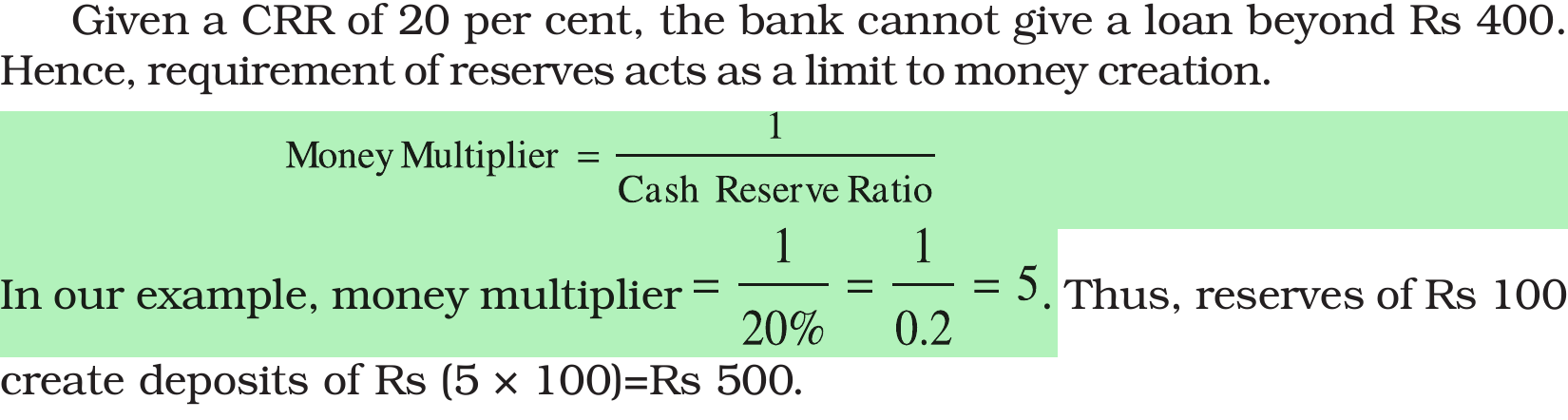
Total money supply is the initial deposit multiplied by the money multiplier, which is 1 divided by the cash reserve ratio:
Money multiplier = 1 ÷ 0.2 = 5
Total money supply = 200 × 5 = ₹1000
NCERT (2026-27): Introductory Macroeconomics — Chapter 3: Money and Banking
NCERT (2026-27): “3.3 Money Creation by Banking System Banks can create money in a manner similar to that as given in Lala’s story. Banks can lend simply because they do not expect all the depositors to withdraw what they have deposited at the same time. When the banks lend to any person, a new deposit is opened in that person’s name. Thus money supply increases to old deposits plus new deposit (plus currency.)…” |