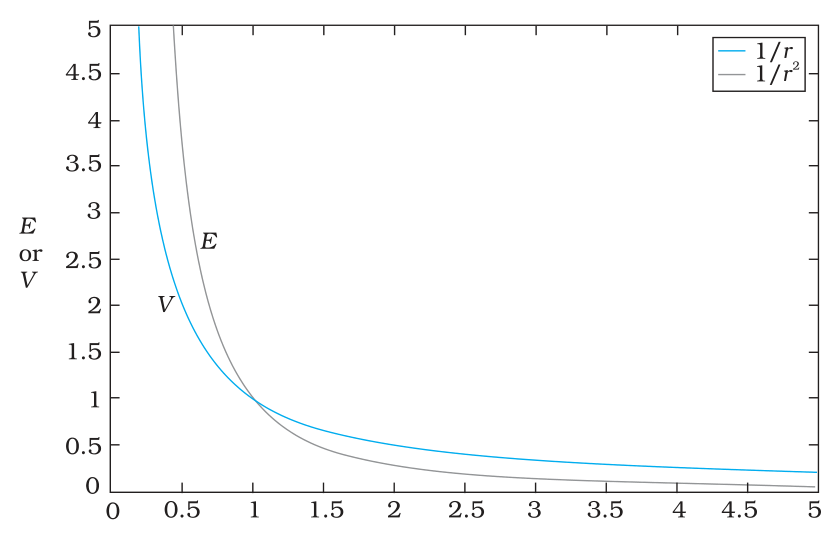
Which one of the following correctly represent the variation of electric field and electric potential with a distance \( r \) from a point charge?
Answer & explanation
Correct answer: option 3
The correct answer is Option (3)
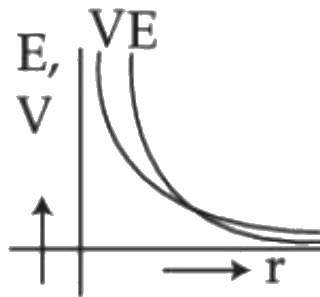
For a point charge the electric field and the potential fall off at different rates:
\( \displaystyle E = \frac{kq}{r^2} \quad\text{and}\quad V = \frac{kq}{r} \)
Their ratio is \( E/V = 1/r \). So for small \( r \) (less than 1 in the units used) \( E \) is larger than \( V \) and falls much faster, while for large \( r \) \( E \) is smaller than \( V \). The two curves must therefore cross: near the axis the \( E \) curve lies outside (above) the \( V \) curve, and after the crossing it lies below it.
In graph (C) the curve labelled E is the outer one at small \( r \) and the curves cross, after which E is the lower curve. This matches \( E \propto 1/r^2 \) and \( V \propto 1/r \).
NCERT (2026-27):
Potential Due to a Point Charge – “… Figure (2.4) shows how the electrostatic potential (∝ 1/r) and the electrostatic field (∝ 1/r2) varies with r.”