
CUETMOCK
  • Pricing
  • Mentors
Log inStart freeStart free mocks→

First test, then trust

Try a free CUET mock test.

Join 5,00,000+ students who rehearsed exam day on the exact NTA screen before sitting CUET. On the web and on Android.

Start free mocks →Get the Android app
CUETMOCK

India's #1 CUET Mock Test Platform. Original NCERT-based questions on the exact NTA exam screen — trusted by 5,00,000+ students since CUET 2022.

Get it onGoogle PlayScan to download the CUETMOCK app

Mock tests

  • CUET mock test series
  • Commerce mocks
  • Humanities (Arts) mocks
  • Science mocks
  • Languages & GAT mocks
  • Free practice questions
  • Pricing

Resources

  • CUET exam guide
  • CUET syllabus
  • Universities accepting CUET
  • Expert blogs
  • News & notifications
  • Webinars & counselling
  • CUET score calculator
  • How we estimate your rank
  • FAQs

Company

  • About us
  • Our leadership & team
  • Our toppers
  • Mentors
  • For schools
  • Contact us
  • Terms
  • Privacy
  • Refund policy

Talk to us

+91 7696 6630 56info@cuetmock.comWhatsApp us

Our other platforms

  • JEE Mock — For IIT-JEE aspirants
  • NEET Mock — For NEET aspirants

Newsletter

Exam updates, study material and offers — no spam.

© 2026 NYC Ventures Pvt. Ltd.

701-702, Royal Business Park, Zirakpur, Punjab - 140603

  • Terms of use
  • Privacy policy
  • Refund policy
  • Contact us

iCUETMOCK is an independent preparation platform, not affiliated with the National Testing Agency (NTA). Always check exam details on the official NTA website.

  • Home
  • Mock tests
  • CUET guide
  • Pricing
  • Log in
Home/Practice questions/Physics
PhysicsRay Optics

What would be the position of the image formed by the lens combinatio…

What would be the position of the image formed by the lens combination in the given figure-
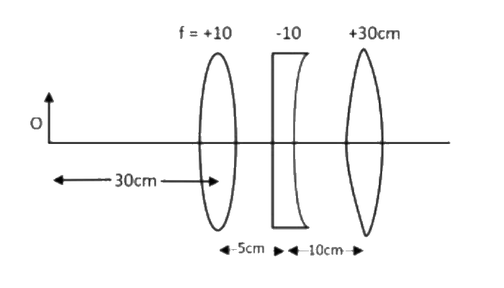
Figure for the question

Answer & explanation+

Correct answer: option 2

The correct answer is Option (2) → 30 cm to the right of the third lens

For lenses in series, the image formed by one lens is the object for the next. Use the lens formula with the Cartesian sign convention (distances measured from each lens, positive in the direction of the incident light), with all distances in cm.

    \( \displaystyle \frac{1}{v} - \frac{1}{u} = \frac{1}{f} \)

First lens: \( u_1 = -30\,\mathrm{cm} \), \( f_1 = +10\,\mathrm{cm} \)

    \( \displaystyle \frac{1}{v_1} = \frac{1}{10} + \frac{1}{-30} = \frac{3 - 1}{30} = \frac{1}{15} \)

    \( \displaystyle v_1 = +15\,\mathrm{cm} \)

The second lens is 5 cm to the right of the first, so this image lies 10 cm beyond the second lens; for the second lens it is a virtual object: \( u_2 = +10\,\mathrm{cm} \), \( f_2 = -10\,\mathrm{cm} \)

    \( \displaystyle \frac{1}{v_2} = \frac{1}{-10} + \frac{1}{10} = 0 \)

    \( \displaystyle v_2 = \infty \)

The light leaving the concave lens is a parallel beam. A parallel beam falling on the third lens (\( f_3 = +30\,\mathrm{cm} \)) converges at its focus, so the final image is 30 cm to the right of the third lens.

Note: It seems that there is a mistake in the original NTA paper, which prints the focal lengths of the first two lenses in the figure as +10 and −10 without a unit when they should read +10 cm and −10 cm. All other distances in the figure are in cm, so the question can still be solved.

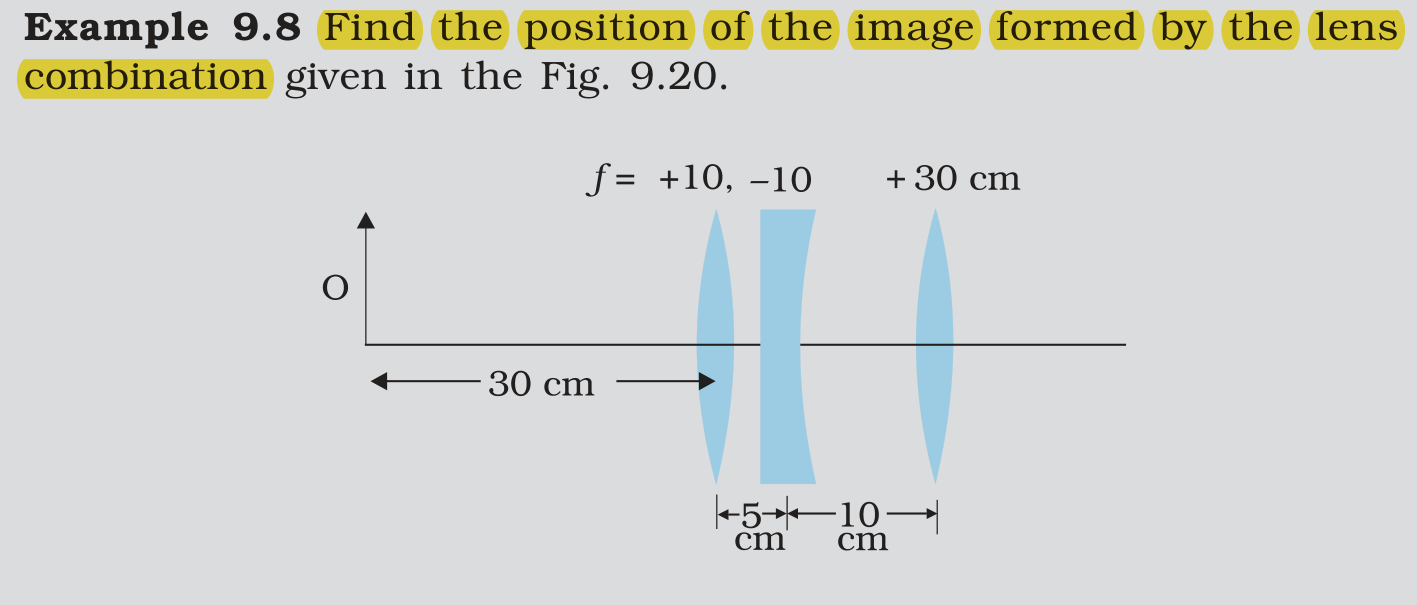
Note: This question is from NCERT (2026-27). NTA sets numerical questions from NCERT too, so do not ignore NCERT while practising numericals.

NCERT (2026-27):
Combination of Thin Lenses in Contact – …
Textbook extract

Advertisement

Practise more on Ray Optics

Chapter-wise mocks on the real NTA exam screen, with solutions and your rank. Your first mocks are free.

Start free mocks →

Advertisement

Next questions

  1. The magnitude of the magnetic field (B) on the axis of a circular current (I) carrying loop of radius R at a distance x from its center is…Physics · Moving Charges and Magnetism
  2. The domain of the function f(x) = sin^-1≤ft((x - 1)/(x + 1)) isMaths. Section B1 · Inverse Trigonometric Functions
  3. The equation of the line passing through the point (2, −1, 3) and perpendicular to both the lines (x-1)/1=(y+2)/2=(3-z)/1 and (x+1)/3=(1-y)…Maths. Section B1 · Three-dimensional Geometry
  4. Rohan walks 6 km towards the North from his school. He then turns to his right and walks 8 km. Consider the following statements: I. Rohan…General Aptitude Test · Verbal Reasoning
  5. Consider the following statements about the uses of amines and their compounds.(A) Novocain, a synthetic amino compound, is used as an anae…Chemistry · Organic: Amines
  6. Consider the surface areas of the following solids.(A) A cuboid of 12 cm long, 7 cm broad, and 5 cm high.(B) A cylinder of radius 3.5 cm an…General Aptitude Test · Quantitative Reasoning
  7. From the given options, choose the pair that carries the same relation as:DILIGENT : HARDWORKINGEnglish · Analogy
  8. Two light sources do not maintain a constant phase difference. If time-averaged intensity distribution in the interference pattern is obtai…Physics · Wave Optics
  9. Which of the following animals chatters?English · Young Ones and Sound
  10. If a function f:R→ T , defined by f(x)=√3sin x+cos x is an onto function, then the interval of T isMaths. Section B1 · Relations and Functions