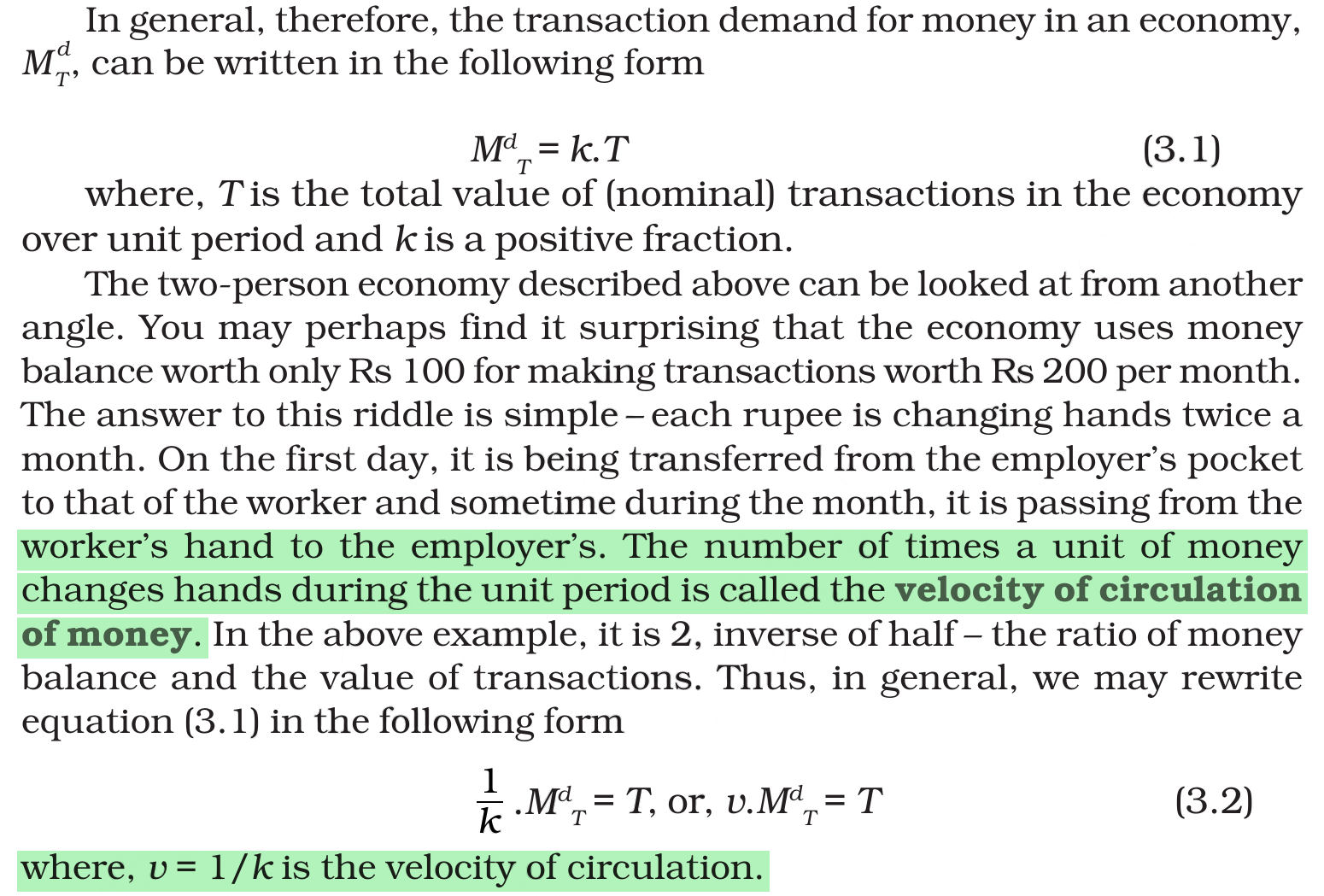
The transaction demand for money in an economy can be written in the following form as,
\( \displaystyle\frac{1}{k}.M_{t}^{d} = T, \text{ or } v.M_{t}^{d} = T \)
in the above expression v refers to:
Answer & explanation
Correct answer: option 1
The correct answer is Option (1) → Velocity of circulation
The same rupee is used again and again: a buyer pays the grocer, the grocer pays the wholesaler, and so on. The number of times a unit of money changes hands during a unit period is its velocity of circulation. Money held for transactions is a fraction k of the value of transactions T, so (1/k) × Mtd = T, and v = 1/k counts how many times each unit is used.
For example, if each rupee changes hands twice a month, money worth Rs.100 can carry transactions worth Rs.200, and v = 1/k = 2.
Why the other options are incorrect
Option (2) Total value of (nominal) transactions — Incorrect. This is T, the right-hand side of the equation, the value of the transactions that money has to carry; v is the number of times money changes hands.
Option (3) Total value of money supply — Incorrect. Money supply is the total stock of money in circulation with the public. The equation contains the transaction demand for money, not money supply, and v is a number of times, not a stock of money.
Option (4) Transaction demand for money — Incorrect. Transaction demand is the money people hold to carry out their transactions. It is the term that v multiplies, Mtd, not v itself.
NCERT: Introductory Macroeconomics — Chapter 3: Money and Banking, Box 3.1: Demand and Supply for Money (2025-26)
|