Arrange the following steps in sequence to calculate the change in income in an economy when there is a change in investment in the economy.
A. Change in consumption in 1st round will become income for the second round
B. In second round calculate Δy
C. Estimate the Amount of investment in 1st round
D. Calculate Amount of money spent in 1st round
E. For the third round find Δy
Choose the correct answer from the options given below:
Answer & explanation
Correct answer: option 3
The correct answer is Option (3) → C, D, A, B, E
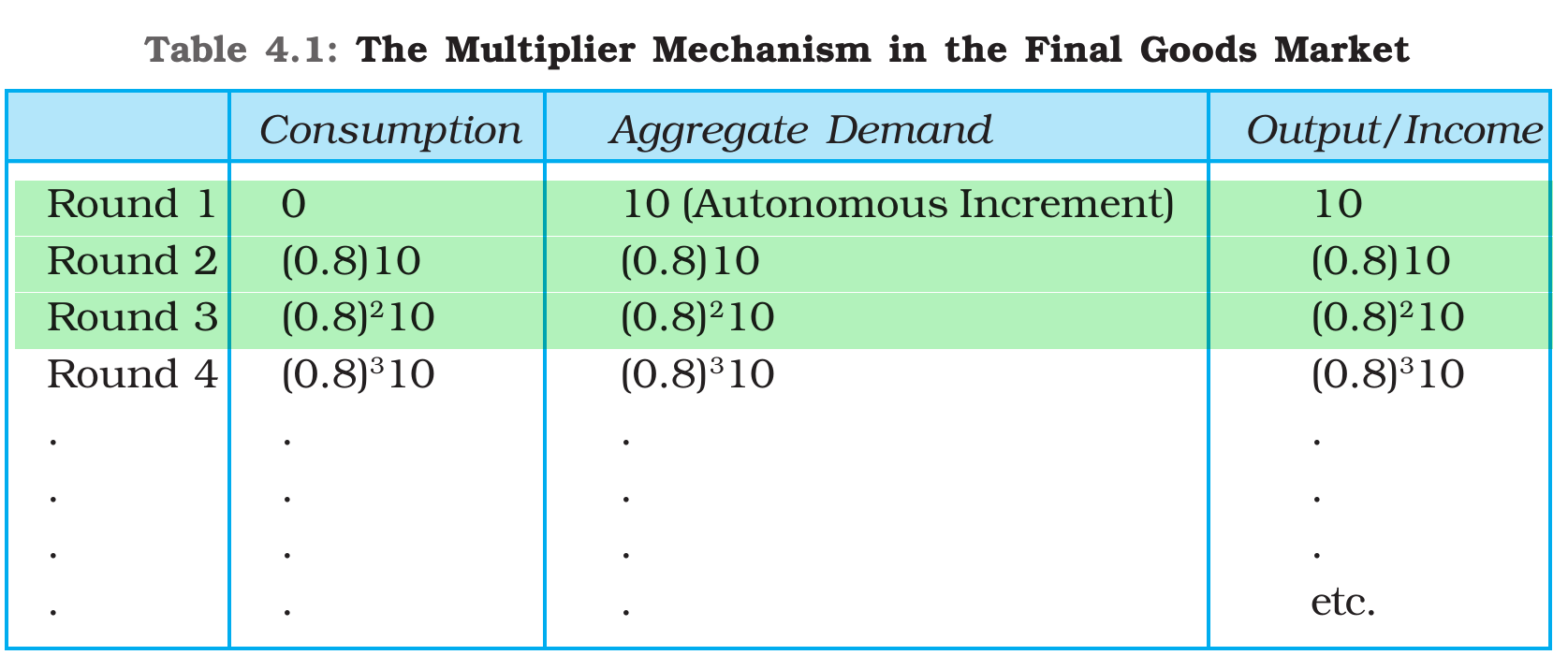
Extra investment raises income by more than itself. Each round of income is partly spent and becomes someone else’s income in the next round. Suppose investment rises by 10 and the marginal propensity to consume (MPC) is 0.8.
(C) Estimate the Amount of investment in 1st round — the extra investment of 10 is spent. So income rises by 10 in the first round.
(D) Calculate Amount of money spent in 1st round — people spend the MPC share of this income: 0.8 × 10 = 8.
(A) Change in consumption in 1st round will become income for the second round — sellers receive the 8 as income in the second round.
(B) In second round calculate Δy — Δy in the second round = 8.
(E) For the third round find Δy — people spend 0.8 of the second round’s income. This spending becomes income again: 0.8 × 8 = 6.4.
NCERT (2026-27): “4.3.3 The Multiplier Mechanism It was seen in the previous section that with a change in the autonomous expenditure of 10 units, the change in equilibrium income is equal to 50 units (from 250 to 300). We can understand this by looking at the multiplier mechanism, which is explained below:… In the above example the value of the extra output, 10, is distributed among various factors as factor payments and hence the income of the economy goes up by 10. When income increases by 10, consumption expenditure goes up by (0.8)10, since people spend 0.8 (= mpc) fraction of their additional income on consumption. Hence, in the next round, aggregate demand in the economy goes up by (0.8)10 and there again emerges an excess demand equal to (0.8)10. Therefore, in the next production cycle, producers increase their planned output further by (0.8)10 to restore equilibrium. When this extra output is distributed among factors, the income of the economy goes up by (0.8)10 and consumption demand increases further by (0.8)210, once again creating excess demand of the same amount. This process goes on, round after round, with producers increasing their output to clear the excess demand in each round and consumers spending a part of their additional income from this extra production on consumption items – thereby creating further excess demand in the next round.”
|