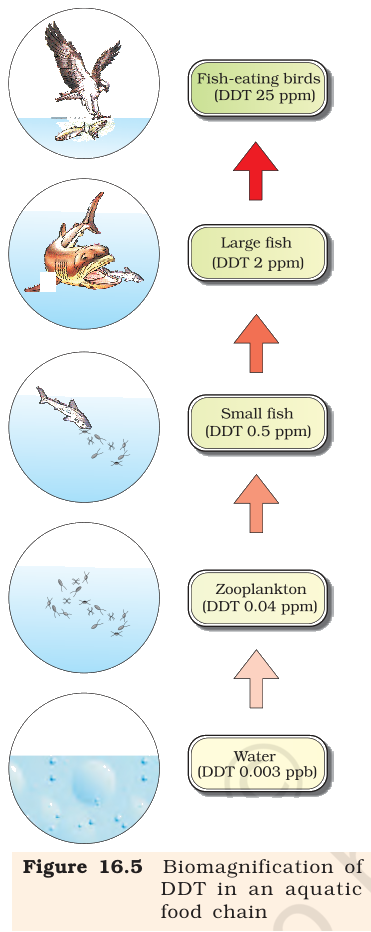
Which of the following has highest level of DDT in an aquatic food chain?
Answer & explanation
Correct answer: option 3
The correct answer is Option (3) → Duck
In the chain water → zooplankton → fish → duck, the fish-eating duck is at the top trophic level, so it carries the most DDT.
Option (1) Water — Incorrect. Water has the lowest level, about 0.003 ppb in NCERT's example.
Option (2) Zooplankton — Incorrect. Zooplankton are the first consumers in this chain and take DDT from the water. DDT builds up at each higher trophic level, so zooplankton hold much less than the fish and the fish-eating birds above them.
Option (3) Duck — Correct. DDT is not broken down in the body, so it builds up at each trophic level; this is biomagnification. The duck, a fish-eating bird, is at the top of this food chain, so it carries the highest level of DDT.
Option (4) Fish — Incorrect. Fish have more DDT than zooplankton but less than the birds that eat them.
Note: This question is from Chapter 16, Environmental Issues, of the pre-rationalised NCERT book. This chapter is not in the present NCERT book (2026-27). The extract below is from the pre-rationalised edition.
NCERT Extract (Pre-rationalised edition, Chapter 16, Environmental Issues):
Domestic Sewage and Industrial Effluents – “… Biomagnification refers to increase in concentration of the toxicant at successive trophic levels. This happens because a toxic substance accumulated by an organism cannot be metabolised or excreted, and is thus passed on to the next higher trophic level. This phenomenon is well-known for mercury and DDT. Figure 16.5 shows biomagnification of DDT in an aquatic food chain. In this manner, the concentration of DDT is increased at successive trophic levels; say if it starts at 0.003 ppb (ppb = parts per billion) in water, it can ultimately reach 25 ppm (ppm = parts per million) in fish-eating birds, through biomagnification.”