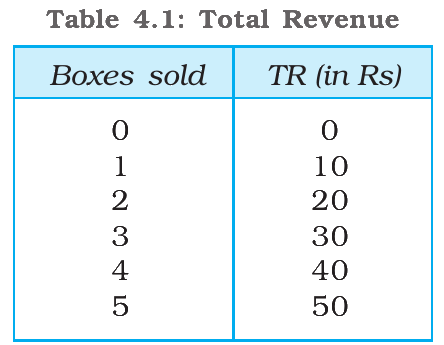
The table below shows the total revenue of a candle maker in a perfectly competitive market:
| Boxes sold | 0 | 1 | 2 | 3 | 4 | 5 |
|---|---|---|---|---|---|---|
| TR (in Rs) | 0 | 10 | 20 | 30 | 40 | 50 |
What are the average revenue and the marginal revenue of the firm when it sells 4 boxes?
Answer & explanation
Correct answer: option 3
The correct answer is Option (3) → AR Rs 10 and MR Rs 10
Given:
TR at 3 boxes = Rs 30
TR at 4 boxes = Rs 40
For a price-taking firm, AR = MR = market price. Here the price is Rs 10 a box.
AR = TR ÷ quantity = 40 ÷ 4 = Rs 10
MR = 40 − 30 = Rs 10
Rs 40 is the total revenue, not the revenue per box or from the extra box.
NCERT (2026-27): “4.2 Revenue … The marginal revenue (MR) of a firm is defined as the increase in total revenue for a unit increase in the firm’s output. … Thus, for the perfectly competitive firm, MR=AR=p In other words, for a price-taking firm, marginal revenue equals the market price. Setting the algebra aside, the intuition for this result is quite simple. When a firm increases its output by one unit, this extra unit is sold at the market price. Hence, the firm’s increase in total revenue from the one-unit output expansion – that is, MR – is precisely the market price.” |