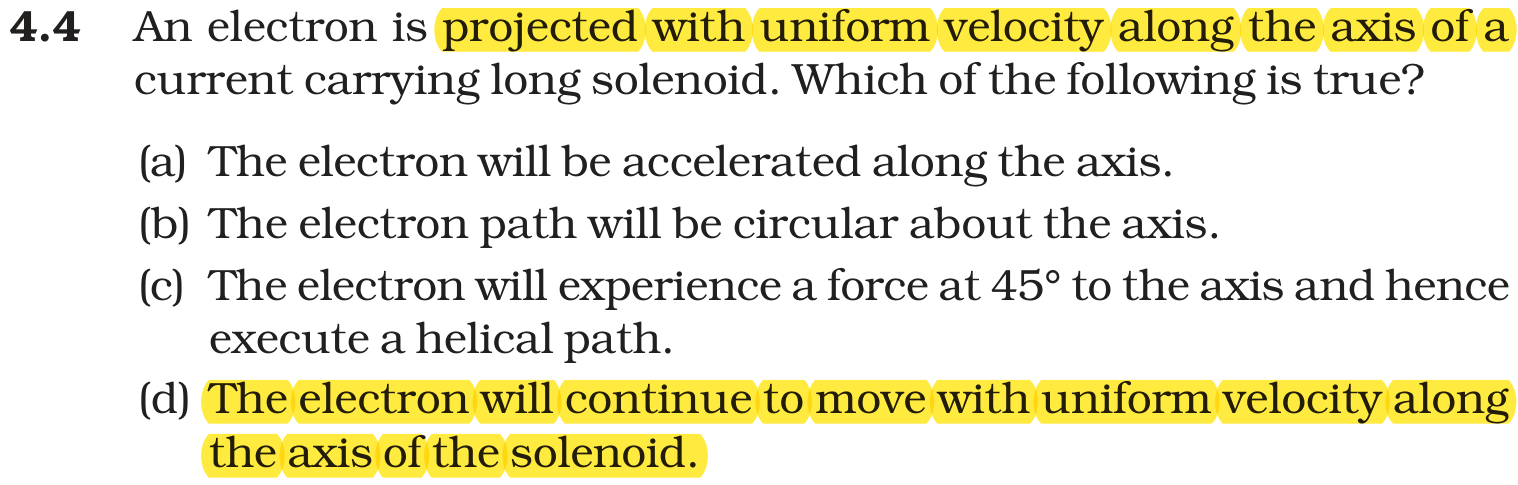
An electron is projected with uniform velocity along the axis of a current carrying long solenoid. Which of the following is true ?
Answer & explanation
Correct answer: option 4
The correct answer is Option (4) → The electron will continue to move with uniform velocity along the axis of the solenoid
Inside a long solenoid the magnetic field is along the axis. The magnetic force on a moving charge is the Lorentz force
\( \displaystyle \vec{F} = -e\,(\vec{v} \times \vec{B}) \)
The electron moves along the axis, so \( \vec{v} \) is parallel to \( \vec{B} \) and
\( \displaystyle F = e\,v\,B\sin 0^\circ = 0 \)
With no force, the electron keeps its velocity.
Option (1) The electron will be accelerated along the axis — Incorrect. A magnetic force is always perpendicular to the velocity and here it is zero, so there is no acceleration along the axis.
Option (2) The electron path will be circular about the axis — Incorrect. A circular path needs a velocity perpendicular to the field; here the velocity is along the field.
Option (3) The electron will have helical path — Incorrect. A helical path needs a velocity inclined to the field, with components both along and across it.
Option (4) The electron will continue to move with uniform velocity along the axis of the solenoid — Correct. \( \vec{v} \parallel \vec{B} \) gives zero force, so the velocity stays uniform along the axis.
NCERT Exemplar:
Moving Charges and Magnetism – …