
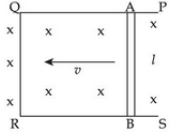
Let a rod AB of length \( l \) having resistance \( r \) is moving perpendicular to a magnetic field B with constant velocity \( v \). If the ends of the rod is connected to a wire PQRS of negligible resistance, then current passing through the wire will be: (see fig.)
Answer & explanation
Correct answer: option 2
The correct answer is Option (2) → \( \displaystyle\frac{Blv}{r} \)
A rod moving perpendicular to a magnetic field has a motional emf across its ends:
\( \displaystyle \varepsilon = B\,l\,v \)
The rod behaves like a cell of emf \( Blv \) with internal resistance \( r \). From the figure, its ends A and B are joined to the frame by two paths, A-Q-R-B and A-P-S-B, and both have negligible resistance. So the external resistance is zero.
\( \displaystyle I = \frac{\varepsilon}{R_{\mathrm{ext}} + r} = \frac{Blv}{0 + r} = \frac{Blv}{r} \)
This current flows through the rod and returns through the wire PQRS.