
Which one of the following is not an example of adaptive radiation ?
Answer & explanation
Correct answer: option 3
The correct answer is Option (3) → Moths in England
Adaptive radiation is the evolution of many different species from one ancestor in a given area, each spreading into a different habitat.
Option (1) Australian Marsupials — An example of adaptive radiation. Many marsupials, each different from the others, evolved from one ancestral stock in Australia.
Option (2) Australian Placental Mammals — An example of adaptive radiation. The placental mammals of Australia also radiated into many varieties, each looking like a matching marsupial.
Option (3) Moths in England — Not an example of adaptive radiation. The rise of dark moths after industrialisation is natural selection within one species (industrial melanism); no new species arose.
Option (4) Darwin’s Finches — An example of adaptive radiation. From seed-eating ancestors on the Galapagos, finches with many kinds of beaks evolved.
NCERT Extract:
What Is Adaptive Radiation? – “… During his journey Darwin went to Galapagos Islands. There he observed an amazing diversity of creatures. Of particular interest, small black birds later called Darwin’s Finches amazed him. He realised that there were many varieties of finches in the same island. All the varieties, he conjectured, evolved on the island itself. From the original seed-eating features, many other forms with altered beaks arose, enabling them to become insectivorous and vegetarian finches (Figure 6.5). This process of evolution of different species in a given geographical area starting from a point and literally radiating to other areas of geography (habitats) is called adaptive radiation. Darwin’s finches represent one of the best examples of this phenomenon. Another example is Australian marsupials. A number of marsupials, each different from the other (Figure 6.6) evolved from an ancestral stock, but all within the Australian island continent. When more than one adaptive radiation appeared to have occurred in an isolated geographical area (representing different habitats), one can call this convergent evolution. Placental mammals in Australia also exhibit adaptive radiation in evolving into varieties of such placental mammals each of which appears to be ‘similar’ to a corresponding marsupial (e.g., Placental wolf and Tasmanian wolf-marsupial).”
Mechanism of Evolution – “… Another interesting observation supporting evolution by natural selection comes from England. In a collection of moths made in 1850s, i.e., before industrialisation set in, it was observed that there were more white-winged moths on trees than dark-winged or melanised moths.”
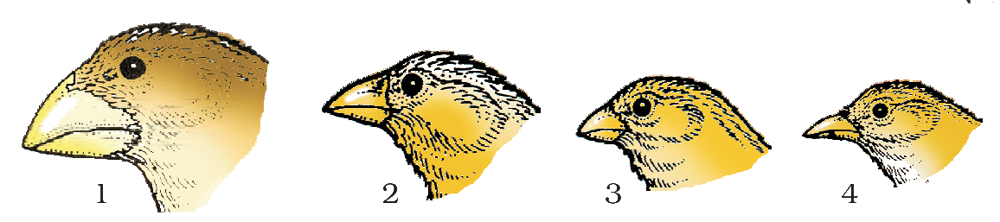
Figure 6.5 Variety of beaks of finches that Darwin found in Galapagos Island