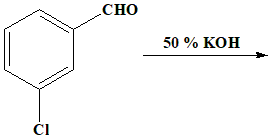
Predict the products in the given reaction:
Answer & explanation
Correct answer: option 3
The correct answer is Option (3) → 3-chlorobenzyl alcohol and 3-chlorobenzoate ion
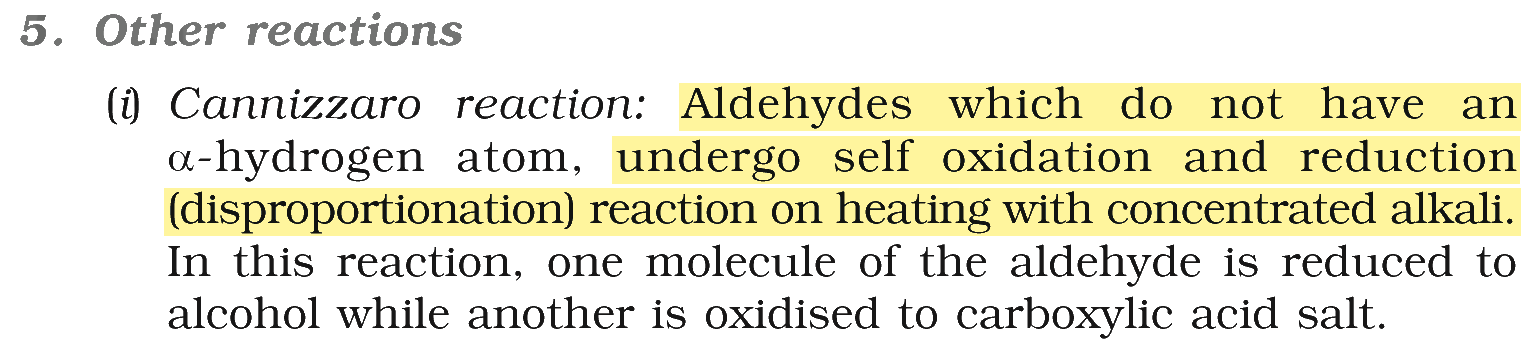
Aldehydes that have no α-hydrogen undergo the Cannizzaro reaction on heating with concentrated alkali: a self oxidation and reduction (disproportionation). One molecule is oxidised to the salt of the carboxylic acid and another is reduced to the alcohol.
3-Chlorobenzaldehyde has its –CHO group on the ring, so it has no α-hydrogen. With 50% KOH the ring and its chlorine stay unchanged; only the –CHO groups react:
\( \ce{2ClC6H4CHO + KOH} \xrightarrow[\Delta]{\text{conc.}} \ce{ClC6H4CH2OH + ClC6H4COO^-K^+} \) (Cl at the 3-position throughout)
So the products are 3-chlorobenzyl alcohol and the 3-chlorobenzoate ion (as its potassium salt).
Why the other options are incorrect
Option (1) 3-chlorobenzyl alcohol and 3-chlorophenylacetate ion — Incorrect. The oxidised product keeps the same carbon skeleton, –CHO → –\( \ce{COO^{-}} \); no extra \( \ce{CH2} \) is added between the ring and the carboxylate.
Option (2) 3-hydroxybenzyl alcohol and resorcinol — Incorrect. The aryl chlorine is not replaced by –OH under these conditions, and the –CHO group is not lost.
Option (4) 3-hydroxybenzyl alcohol and benzoate ion — Incorrect. The chlorine is neither replaced by –OH nor removed; both products keep the Cl atom.
NCERT (2026-27 edition):
Chemical Reactions – …