If the sequence of one strand of DNA is written as: 5′- ATCGTGCTATGAGCATGC-3′.
The sequence of its complementary strands will be?
Answer & explanation
Correct answer: option 2
The correct answer is Option (2) → 3′- TAGCACGATACTCGTACG-5′
Pairing base by base, with the new strand running 3′→5′:
5′- ATCGTGCTATGAGCATGC-3′
3′- TAGCACGATACTCGTACG-5′
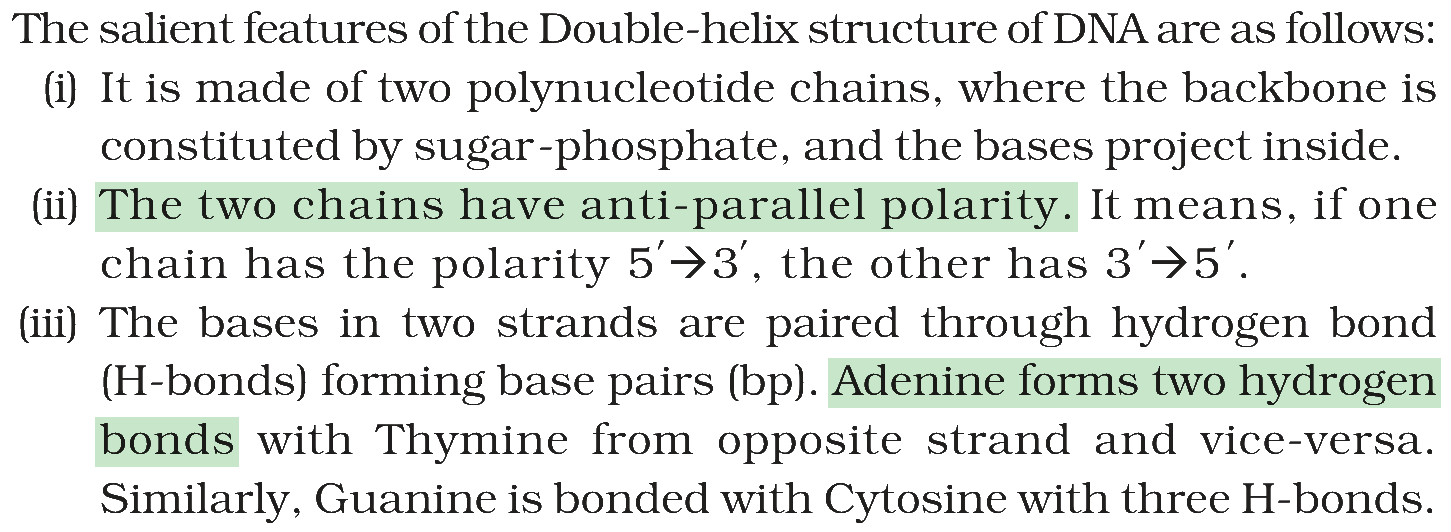
Option (1) 5′- TAGCACGATACTCGTACG-3′ — Incorrect. The bases are right, but the ends are labelled 5′ to 3′, as if both strands ran the same way. DNA strands are anti-parallel.
Option (2) 3′- TAGCACGATACTCGTACG-5′ — Correct. Every base pairs with the one opposite it, and the strand runs 3′→5′.
Option (3) 3′ UAGCACGUAACTCGTACG 5′ — Incorrect. DNA has no uracil (U); uracil is found in RNA. This strand also pairs T with U in some places and with A in others.
Option (4) 3′- UAGCACGAUACUCGUACG-5′ — Incorrect. This is the sequence an RNA copy would have, with U in place of every T. The question asks for the complementary strand of DNA.
NCERT Extract:
Structure of Polynucleotide Chain – …