Benzene ring in phenol is expected to give the characteristic substitution or replacement reactions, i.e., halogenation, nitration, sulphonation, alkylation, etc. In these reactions, the attacking reagent is electrophile. The phenolic group activates the ortho and para positions in the ring due to conjugation. Disubstitution reactions are quite fast as the electron density in the ring has increased considerably. Phenols do not respond to nucleophilic substitution reactions as it is influenced by phenolic group.
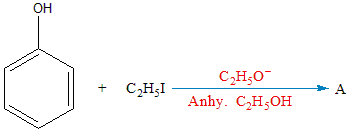
A is :
Answer & explanation
Correct answer: option 3
The correct answer is Option (3) → C6H5OC2H5
Note: The given answer is as per the official NTA Answer Key. However, there is more than one correct option for this question, as explained below.
This is the Williamson synthesis: an alkoxide or phenoxide ion displaces the halide of a primary alkyl halide by an SN2 reaction and forms an ether. Phenol is more acidic than ethanol, so ethoxide first converts it into the phenoxide ion.
\( \ce{C6H5OH + C2H5O- -> C6H5O- + C2H5OH} \)
Option (1) C2H5OC2H5 — Is also correct. The ethoxide ion is itself a strong nucleophile and is present with ethyl iodide in the same flask, so it can also undergo the Williamson reaction and give diethyl ether.
\( \ce{C2H5O- + C2H5I -> C2H5OC2H5 + I-} \)
Option (2) (iodobenzene and ethanol) — Incorrect. The C–O bond of phenol has partial double-bond character and is not broken, so an aryl iodide is not formed.
Option (3) C6H5OC2H5 — Correct. The phenoxide ion attacks the primary carbon of ethyl iodide and displaces iodide, giving ethoxybenzene (phenetole).
\( \ce{C6H5O- + C2H5I -> C6H5OC2H5 + I-} \)
Option (4) C6H5OC6H5 — Incorrect. Diphenyl ether would need an aryl halide as the electrophile, and aryl halides do not undergo SN2 reactions.
NCERT (2026-27 edition):
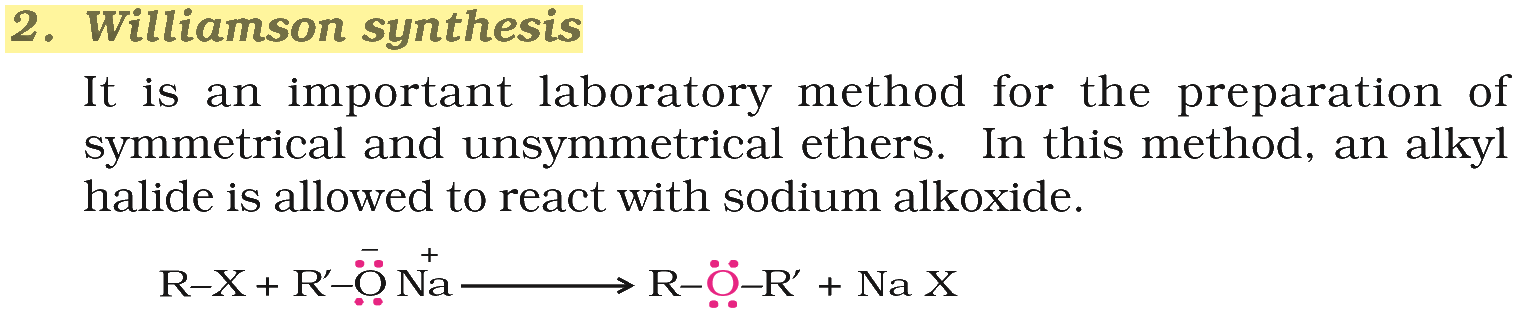
Williamson Synthesis