
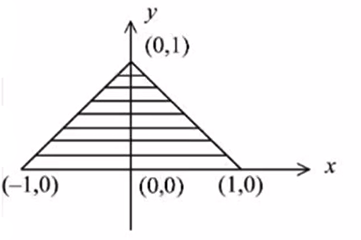
The shaded region is represented by the integral
Answer & explanation
Correct answer: option 2
The correct answer is Option (2) → \(\int_{-1}^{1}\displaystyle (1-|x|)\,dx\)
The shaded region is the triangle with vertices (−1, 0), (0, 1) and (1, 0), lying above the x-axis.
Its upper boundary is made of two lines:
from (−1, 0) to (0, 1): \(y=1+x\), for \(-1\le x\le 0\)
from (0, 1) to (1, 0): \(y=1-x\), for \(0\le x\le 1\)
Both pieces are given by one formula using the modulus:
\(y=1-|x|\), for \(-1\le x\le 1\)
So the area of the shaded region is
\( \displaystyle \int_{-1}^{1}(1-|x|)\,dx \)
(Its value is 1, the area of a triangle with base 2 and height 1.)
Why the other options are incorrect
Option (1) \(\int_{-1}^{1}\displaystyle (1-x)\,dx\) — Incorrect. y = 1 − x is only the right edge; on [−1, 0] it rises to 2 at x = −1 and does not follow the left edge of the triangle (its value is 2, not 1).
Option (3) \(\int_{0}^{1}\displaystyle x\,dx\) — Incorrect. It is the area under y = x from 0 to 1, a different triangle (value 1/2).
Option (4) \(\int_{-1}^{1}\displaystyle |x|\,dx\) — Incorrect. It is the area between the x-axis and the V-shaped graph y = |x|: two small triangles with a vertex at the origin, not the shaded triangle (its value also happens to be 1, but it is a different region).