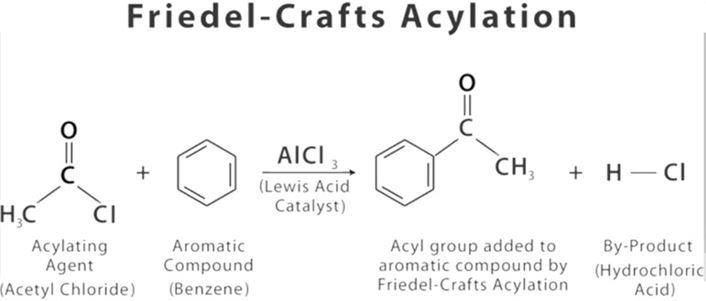
Match List-I with List-II
|
List-I |
List-II |
|
(A) Gatterman-Koch reaction |
(I) $CrO_2Cl_2/CS_2$ |
|
(B) Rosenmund reduction |
(II) Acyl chloride and anhyd. $AlCl_3$ |
|
(C) Etard reaction |
(III) $CO, HCl, AlCl_3/CUCl$ |
|
(D) Friedel Craft acylation |
(IV) $H_2/Pd-BaSO_4$ |
Choose the correct answer from the options given below:
Answer & explanation
Correct answer: option 4
The correct answer is Option (4) → (A)-(III), (B)-(IV), (C)-(I), (D)-(II)
|
List-I |
List-II |
|
(A) Gatterman-Koch reaction |
(III) $CO, HCl, AlCl_3/CUCl$ |
|
(B) Rosenmund reduction |
(IV) $H_2/Pd-BaSO_4$ |
|
(C) Etard reaction |
(I) $CrO_2Cl_2/CS_2$ |
|
(D) Friedel Craft acylation |
(II) Acyl chloride and anhyd. $AlCl_3$ |
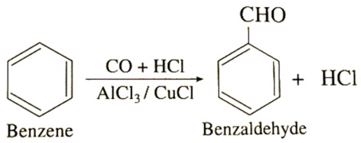
(A) Gattermann–Koch reaction $\rightarrow$ (III) $\text{CO}, \text{HCl}, \text{AlCl}_3/\text{CuCl}$
This reaction introduces a formyl group ($-\text{CHO}$) into an aromatic ring. $\text{CO}$ and $\text{HCl}$ in the presence of $\text{AlCl}_3/\text{CuCl}$ generate the electrophile needed for formylation.
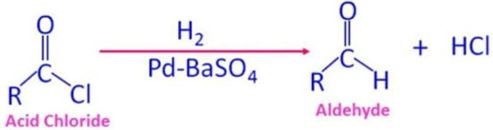
(B) Rosenmund reduction $\rightarrow$ (IV) $\text{H}_2 / \text{Pd}-\text{BaSO}_4$
Used to convert acid chlorides into aldehydes. The Palladium catalyst is poisoned with $\text{BaSO}_4$ to prevent further reduction to alcohol.
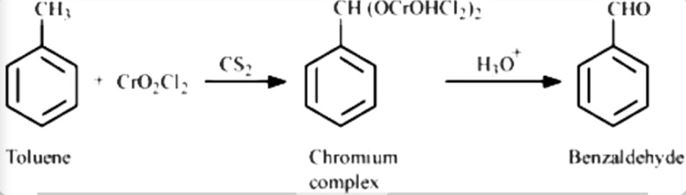
(C) Etard reaction $\rightarrow$ (I) $\text{CrO}_2\text{Cl}_2$ / $\text{CS}_2$
This reaction oxidizes the methyl group attached to benzene to an aldehyde. Chromyl chloride is the characteristic reagent.
(D) Friedel–Crafts acylation $\rightarrow$ (II) Acyl chloride/anhydride + $\text{AlCl}_3$
Introduces an acyl group ($-\text{COR}$) into an aromatic ring. $\text{AlCl}_3$ acts as a Lewis acid to generate the acylium ion electrophile.