Which of the following reactions do not produce Manganese dioxide?
Answer & explanation
Correct answer: option 2
The correct answer is Option (2) → 10I− + 2MnO4− + 16H+ →
Potassium permanganate is a strong oxidising agent, and its reduction product depends on the medium:
Acidic medium: \( \ce{MnO4^{-}} \) (+7) gains 5 electrons and becomes Mn2+ (+2).
\( \displaystyle \ce{MnO4^- + 8H^+ + 5e^- -> Mn^2+ + 4H2O} \)
Neutral or faintly alkaline medium: \( \ce{MnO4^{-}} \) gains 3 electrons and becomes MnO2 (+4).
\( \displaystyle \ce{MnO4^- + 2H2O + 3e^- -> MnO2 + 4OH^-} \)
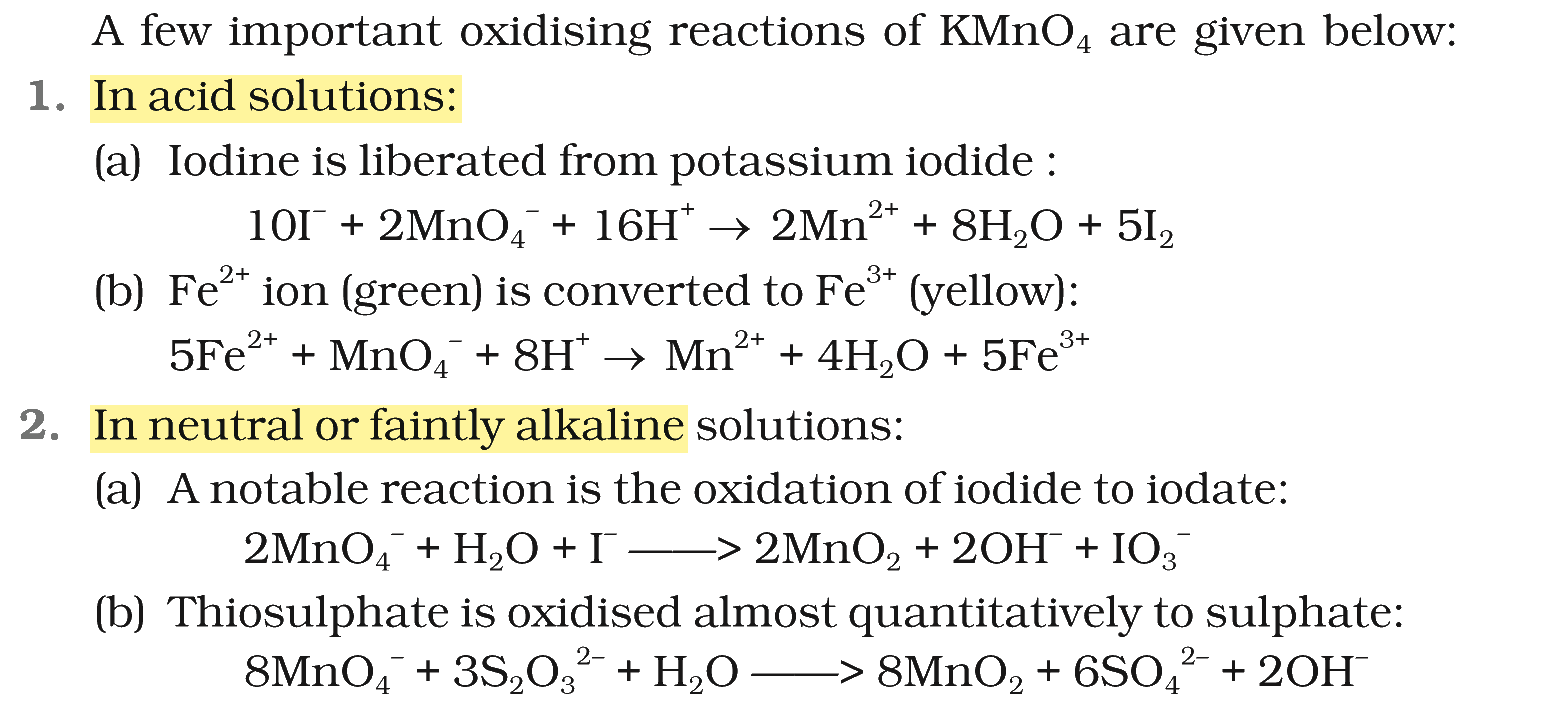
Option (1) 2MnO4− + H2O + I− → — Produces manganese dioxide. In neutral or faintly alkaline solution, iodide is oxidised to iodate:
\( \displaystyle \ce{2MnO4^- + H2O + I^- -> 2MnO2 + 2OH^- + IO3^-} \)
Option (2) 10I− + 2MnO4− + 16H+ → — Does not produce manganese dioxide (gives Mn2+). The \( \ce{H^{+}} \) ions make the medium acidic, so iodide is oxidised to iodine and permanganate goes to \( \ce{Mn^{2+}} \):
\( \displaystyle \ce{10I^- + 2MnO4^- + 16H^+ -> 2Mn^2+ + 8H2O + 5I2} \)
Option (3) 2KMnO4 \( \xrightarrow{\Delta} \) — Produces manganese dioxide. On heating, \( \ce{KMnO4} \) decomposes:
\( \displaystyle \ce{2KMnO4} \xrightarrow{\Delta} \ce{K2MnO4 + MnO2 + O2} \)
Option (4) 8MnO4− + 3S2O82− + H2O → — Produces manganese dioxide. In neutral or faintly alkaline solution, permanganate oxidises thiosulphate to sulphate; the 8 : 3 ratio balances only with thiosulphate:
\( \displaystyle \ce{8MnO4^- + 3S2O3^2- + H2O -> 8MnO2 + 6SO4^2- + 2OH^-} \)
Note: It seems that there is a mistake in the original NTA paper, which prints S2O82− (peroxodisulphate) in Option (4) when it should read S2O32− (thiosulphate).
NCERT (2026-27 edition):
Potassium Permanganate – …