
CUETMOCK
  • Pricing
  • Mentors
Log inStart freeStart free mocks→

First test, then trust

Try a free CUET mock test.

Join 5,00,000+ students who rehearsed exam day on the exact NTA screen before sitting CUET. On the web and on Android.

Start free mocks →Get the Android app
CUETMOCK

India's #1 CUET Mock Test Platform. Original NCERT-based questions on the exact NTA exam screen — trusted by 5,00,000+ students since CUET 2022.

Get it onGoogle PlayScan to download the CUETMOCK app

Mock tests

  • CUET mock test series
  • Commerce mocks
  • Humanities (Arts) mocks
  • Science mocks
  • Languages & GAT mocks
  • Free practice questions
  • Pricing

Resources

  • CUET exam guide
  • CUET syllabus
  • Universities accepting CUET
  • Expert blogs
  • News & notifications
  • Webinars & counselling
  • CUET score calculator
  • How we estimate your rank
  • FAQs

Company

  • About us
  • Our leadership & team
  • Our toppers
  • Mentors
  • For schools
  • Contact us
  • Terms
  • Privacy
  • Refund policy

Talk to us

+91 7696 6630 56info@cuetmock.comWhatsApp us

Our other platforms

  • JEE Mock — For IIT-JEE aspirants
  • NEET Mock — For NEET aspirants

Newsletter

Exam updates, study material and offers — no spam.

© 2026 NYC Ventures Pvt. Ltd.

701-702, Royal Business Park, Zirakpur, Punjab - 140603

  • Terms of use
  • Privacy policy
  • Refund policy
  • Contact us

iCUETMOCK is an independent preparation platform, not affiliated with the National Testing Agency (NTA). Always check exam details on the official NTA website.

  • Home
  • Mock tests
  • CUET guide
  • Pricing
  • Log in
Home/Practice questions/Chemistry
ChemistryOrganic: Haloalkanes and Haloarenes

Which of the following is not expected to be an intermediate during t…

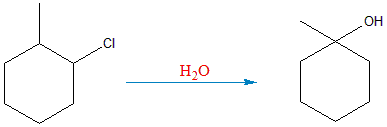
Which of the following is not expected to be an intermediate during the given reaction?
Answer & explanation+

Correct answer: option 2

The correct answer is Option (2) → the cyclohexylmethyl cation, a primary carbocation (positive charge on the \( \ce{CH2} \) outside the ring)

In water, a polar protic solvent, 1-chloro-2-methylcyclohexane reacts by the SN1 route: the C–Cl bond breaks first to give a carbocation, and water then attacks it. A carbocation can rearrange to a more stable one (3° > 2° > 1°) before water attacks, which is why the –OH ends up on the carbon that carries the methyl group.

  • Ionisation: the C–Cl bond breaks slowly and gives the 2-methylcyclohexyl cation, a secondary carbocation (Option 4), and \( \ce{Cl^-} \).

  • Hydride shift: the H atom on the next ring carbon (the one carrying \( \ce{CH3} \)) moves over with its electron pair. The positive charge passes to that carbon and gives the 1-methylcyclohexyl cation, a more stable tertiary carbocation (Option 1).

  • Attack of water: a water molecule adds to the tertiary carbocation and gives the protonated alcohol (an oxonium ion) (Option 3).

  • Deprotonation: the oxonium ion loses \( \ce{H^+} \) to the solvent and gives 1-methylcyclohexan-1-ol, the product shown.

How each option fits the reaction

Option (1) the 1-methylcyclohexyl cation (tertiary) — An intermediate in this reaction. It forms by the hydride shift and is the carbocation that water attacks.

Option (2) the cyclohexylmethyl cation (primary) — Not an intermediate in this reaction. No C–Cl bond sits on the \( \ce{CH2} \), and the shift goes from the secondary to the more stable tertiary carbocation, never to a less stable primary one. Had it formed, the product would be cyclohexylmethanol, not the alcohol shown.

Option (3) protonated 1-methylcyclohexan-1-ol — An intermediate in this reaction. It forms when water attacks the tertiary carbocation and gives the product on losing \( \ce{H^+} \).

Option (4) the 2-methylcyclohexyl cation (secondary) — An intermediate in this reaction. It is the first carbocation, formed when the C–Cl bond breaks.

NCERT (2026-27 edition):
(b) Substitution nucleophilic unimolecular (SN1) – “SN1 reactions are generally carried out in polar protic solvents (like water, alcohol, acetic acid, etc.). … It occurs in two steps. In step I, the polarised C—Br bond undergoes slow cleavage to produce a carbocation and a bromide ion. The carbocation thus formed is then attacked by nucleophile in step II to complete the substitution reaction.”

Exercises, 7.33 (3-methylbutan-2-ol treated with HBr) – “Hint : The secondary carbocation formed in step II rearranges to a more stable tertiary carbocation by a hydride ion shift from 3rd carbon atom.”

Advertisement

Practise more on Organic: Haloalkanes and Haloarenes

Chapter-wise mocks on the real NTA exam screen, with solutions and your rank. Your first mocks are free.

Start free mocks →

Advertisement

Next questions

  1. Which of the following statements about restriction enzymes is incorrect?Biology · Biotechnology -Principles and Processes
  2. In which year did the Government of India legalise MTP?Biology · Reproductive Health
  3. Which of the following are vector quantities? (A) Displacement(B) Time period(C) Force(D) Work done Choose the correct answer from the opti…Maths. Section B1 · Vectors
  4. The Communist Party of the Soviet Union sought to reform the system in 1985 because-Political Science · Contemporary World Politics: End of Bi-Polarity
  5. Akbar’s atelier translated and illustrated revered Hindu texts. Consider the following statements:(A) The translation and illustration of t…Fine Arts · The Mughal School of Miniature Painting
  6. Only a few places are mentioned for the Malwa School’s origin. Which one of the following places is the odd one out?Fine Arts · The Rajasthani Schools of Painting
  7. Which of the following statements is false?Chemistry · Physical: Chemical Kinetics
  8. The writer’s remark that a diary ‘is meant to catch you before you have tidied yourself up’ implies thatEnglish · Comprehension - (Narrative / Factual)
  9. The Company letter Meera reads shows what officials hoped the settlement would create in rural Bengal. Which class did they hope would emer…History · Modern India: Colonialism and the Countryside
  10. In the scheme of untouchability, what followed when the mere touch of an 'untouchable' person fell on members of other castes?Sociology · Indian Society: Patterns of Social Inequality and Exclusion