
Potentiometer has multiple uses. It is based on the principle that when constant current flows through a wire of uniform area of cross-section then potential drop along its length is directly proportional to corresponding length.
i.e. $V \propto I$
$V=K I$
Various uses of potentiometer on:
- To measure potential differences between any two points in an electrical network
- To compare emf of a cell
- To measure emf of a cell
- To measure internal resistance of a cell etc.
Answer the following question related to potentiometer:
The length of potentiometer wire AB is 10 m and its resistance is 8Ω. If balancing length on the potentiometer is 225 cm, the value of emf of the primary cell is:
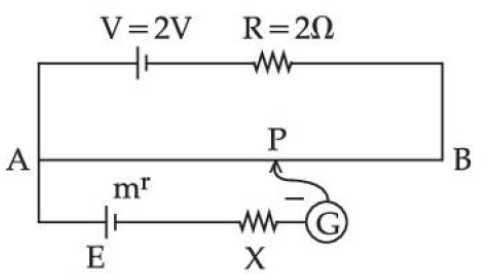
Answer & explanation
Correct answer: option 1
The correct answer is Option (1) → 0.36 volt
Potential gradient per unit length = $\frac{i × R_{A B}}{l}$
$\Rightarrow v=\frac{2}{2+8} × \frac{8}{10}=\frac{1}{5} × \frac{8}{10}$
Now, emf of primary cell = Potential gradient × Balancing length
$=\frac{1}{5} × \frac{8}{10} × \frac{225}{100}$ = 0.36 volt