
CUETMOCK
  • Pricing
  • Mentors
Log inStart freeStart free mocks→

First test, then trust

Try a free CUET mock test.

Join 5,00,000+ students who rehearsed exam day on the exact NTA screen before sitting CUET. On the web and on Android.

Start free mocks →Get the Android app
CUETMOCK

India's #1 CUET Mock Test Platform. Original NCERT-based questions on the exact NTA exam screen — trusted by 5,00,000+ students since CUET 2022.

Get it onGoogle PlayScan to download the CUETMOCK app

Mock tests

  • CUET mock test series
  • Commerce mocks
  • Humanities (Arts) mocks
  • Science mocks
  • Languages & GAT mocks
  • Free practice questions
  • Pricing

Resources

  • CUET exam guide
  • CUET syllabus
  • Universities accepting CUET
  • Expert blogs
  • News & notifications
  • Webinars & counselling
  • CUET score calculator
  • How we estimate your rank
  • FAQs

Company

  • About us
  • Our leadership & team
  • Our toppers
  • Mentors
  • For schools
  • Contact us
  • Terms
  • Privacy
  • Refund policy

Talk to us

+91 7696 6630 56info@cuetmock.comWhatsApp us

Our other platforms

  • JEE Mock — For IIT-JEE aspirants
  • NEET Mock — For NEET aspirants

Newsletter

Exam updates, study material and offers — no spam.

© 2026 NYC Ventures Pvt. Ltd.

701-702, Royal Business Park, Zirakpur, Punjab - 140603

  • Terms of use
  • Privacy policy
  • Refund policy
  • Contact us

iCUETMOCK is an independent preparation platform, not affiliated with the National Testing Agency (NTA). Always check exam details on the official NTA website.

  • Home
  • Mock tests
  • CUET guide
  • Pricing
  • Log in
Home/Practice questions/Physics
PhysicsAtoms

Which of the following is/are correct about the scattering experiment…

Read the following passage and answer the questions.

In 1911, H. Geiger and E. Marsden did a scattering experiment suggested by Rutherford. A radioactive source of \({}^{214}_{83}\mathrm{Bi}\) gave out alpha-particles of energy 5.5 MeV. The alpha-particles passed through lead bricks and then fell on a gold foil. The foil was only \(2.1\times10^{-7}\ \mathrm{m}\) thick. A detector made of a zinc sulphide screen and a microscope was placed near the foil. The detector could be turned around the foil. The whole apparatus was kept in a vacuum chamber. An alpha-particle carries a positive charge \(2e\). A gold nucleus carries a positive charge \(Ze\), with \(Z = 79\) for gold. The graph below shows the number of scattered alpha-particles detected at different scattering angles.
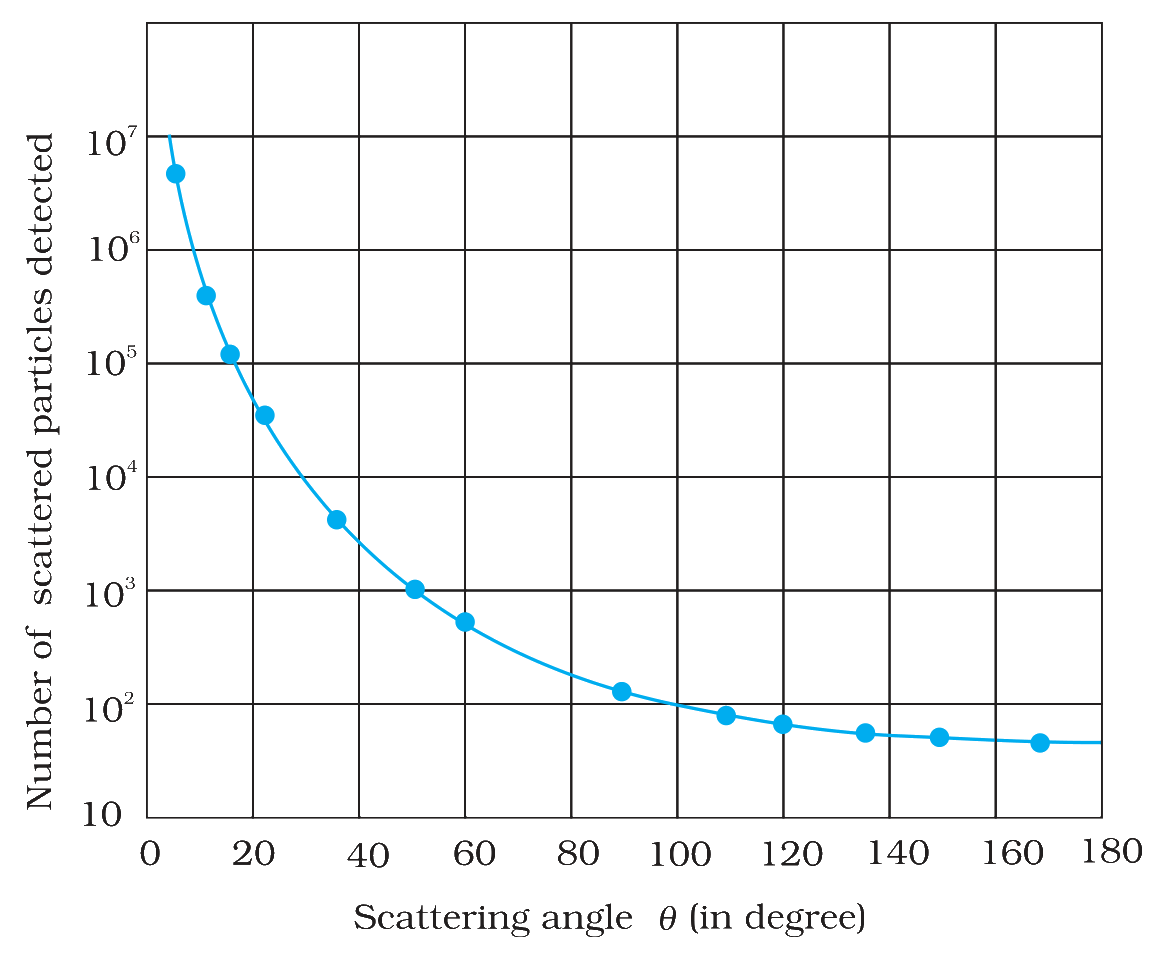
Graph of the number of scattered alpha-particles detected against the scattering angle

Which of the following is/are correct about the scattering experiment and the graph shown?

Answer & explanation+

Correct answer: option 4

The correct answer is Option (4) → All of the above

Option (1) Many of the α-particles pass through the gold foil without undergoing any deflection. — Incorrect. This statement is true. But it is not the only true statement here.

Option (2) Very few, only about one in 8000, are scattered by more than \( 90^\circ \). — Incorrect. This statement is also true. It too is only part of the full answer.

Option (3) The solid curve depicts the prediction of Rutherford’s nuclear model. — Incorrect. This statement holds as well, so choosing it alone leaves out the other two.

Option (4) All of the above — Correct. All three statements hold:

  • In Rutherford’s nuclear model, the positive charge and most of the mass sit in a tiny nucleus. The nucleus is 10,000 to 100,000 times smaller than the atom. So most α-particles go straight through the foil without any collision, and (1) holds.

  • An α-particle is turned through a large angle only when it comes close to a nucleus. Such close approaches are rare. So only about 1 in 8000 is deflected beyond \( 90^\circ \), and (2) holds.

  • In the figure, the dots are the measured data points. The solid curve is the theoretical prediction for an atom with a small, dense, positive nucleus, so (3) holds.

NCERT (2026-27):
Alpha-particle Scattering and Rutherford’s Nuclear Model of Atom – “… The dots in this figure represent the data points and the solid curve is the theoretical prediction based on the assumption that the target atom has a small, dense, positively charged nucleus. Many of the α-particles pass through the foil. It means that they do not suffer any collisions. Only about 0.14% of the incident α-particles scatter by more than 1°; and about 1 in 8000 deflect by more than 90°.”

Advertisement

Practise more on Atoms

Chapter-wise mocks on the real NTA exam screen, with solutions and your rank. Your first mocks are free.

Start free mocks →

Advertisement

Next questions

  1. The Indian Penal Code was passed in 1860 came into force in which year?Legal Studies · Topics of Law
  2. Which party did Chaudhary Charan Singh leave to form the Bharatiya Kranti Dal in 1967?1) Indian National Congress2) Bharatiya Janata Party…Political Science · Politics in India Since Independence: Crisis of democratic Order
  3. Select the Venn Diagram, the best represents the relationships between the following words. Air, Ice, NitrogenGeneral Aptitude Test · Verbal Reasoning
  4. Who among the following was the founder and the first Chairman and Commissioner of the Indian Premier League (IPL)?General Aptitude Test · General Knowledge
  5. Which of the following statements about bromine is correct?General Aptitude Test · General Knowledge
  6. Which one of the following best explains the word ‘Bibliography’?English · Study of Subject
  7. Select the option that is related to the third term in the same way as the second term is related to the first term. RIGHT : UGKKR : : CHAO…General Aptitude Test · General Ability
  8. Let l,m,n be the direction cosines of a vector thenMaths. Section B1 · Vectors
  9. Choose the word that describes the best antonym (opposite) of the following words. MeticulousEnglish · Antonyms
  10. Choose the appropriate word to complete the following sentence:Let us pick some other film for tonight. I have seen this one ______ and sti…English · Grammar: Adverb