
CUETMOCK
  • Pricing
  • Mentors
Log inStart freeStart free mocks→

First test, then trust

Try a free CUET mock test.

Join 5,00,000+ students who rehearsed exam day on the exact NTA screen before sitting CUET. On the web and on Android.

Start free mocks →Get the Android app
CUETMOCK

India's #1 CUET Mock Test Platform. Original NCERT-based questions on the exact NTA exam screen — trusted by 5,00,000+ students since CUET 2022.

Get it onGoogle PlayScan to download the CUETMOCK app

Mock tests

  • CUET mock test series
  • Commerce mocks
  • Humanities (Arts) mocks
  • Science mocks
  • Languages & GAT mocks
  • Free practice questions
  • Pricing

Resources

  • CUET exam guide
  • CUET syllabus
  • Universities accepting CUET
  • Expert blogs
  • News & notifications
  • Webinars & counselling
  • CUET score calculator
  • How we estimate your rank
  • FAQs

Company

  • About us
  • Our leadership & team
  • Our toppers
  • Mentors
  • For schools
  • Contact us
  • Terms
  • Privacy
  • Refund policy

Talk to us

+91 7696 6630 56info@cuetmock.comWhatsApp us

Our other platforms

  • JEE Mock — For IIT-JEE aspirants
  • NEET Mock — For NEET aspirants

Newsletter

Exam updates, study material and offers — no spam.

© 2026 NYC Ventures Pvt. Ltd.

701-702, Royal Business Park, Zirakpur, Punjab - 140603

  • Terms of use
  • Privacy policy
  • Refund policy
  • Contact us

iCUETMOCK is an independent preparation platform, not affiliated with the National Testing Agency (NTA). Always check exam details on the official NTA website.

  • Home
  • Mock tests
  • CUET guide
  • Pricing
  • Log in
Home/Practice questions/Chemistry
ChemistryOrganic: Alcohols, Phenols and Ethers

What type of alcohol is compound “A”?

Alcohols

Alcohols are formed when a hydrogen atom in aliphatic hydrocarbon is replaced by –OH group. Alcohols are classified as primary, secondary and tertiary alcohols depending on the attachment of –OH group to primary, secondary and tertiary carbon atom, respectively. In alcohols, the oxygen of the –OH group is attached to carbon by a sigma (σ) bond formed by the overlap of a sp3 hybridised orbital of carbon with a sp3 hybridised orbital of oxygen. Alcohols consist of two parts, an alkyl group and a hydroxyl group. The properties of alcohols are chiefly due to the hydroxyl group. The nature of alkyl groups simply modify these properties. The boiling points of alcohols increase with increase in the number of carbon atoms (increase in van der Waals forces). In alcohols, the boiling points decrease with increase of branching in carbon chain (because of decrease in van der Waals forces with decrease in surface area). Alcohols undergo dehydration (removal of a molecule of water) to form alkenes on treating with a protic acid e.g., concentrated H2SO4 or H3PO4, or catalysts such as anhydrous zinc chloride or alumina. Alcohols are versatile compounds. They act both as nucleophiles and electrophiles. An alcohol with molecular formula C4H10O (A) is prepared by the reduction of corresponding ketone. A is also prepared by the reaction of propanal with methylmagnesium bromide followed by hydrolysis. Compound A on dehydration gives alkene (B).

What type of alcohol is compound “A”?

Answer & explanation+

Correct answer: option 2

The correct answer is Option (2) → Secondary aliphatic

An alcohol is primary, secondary or tertiary according to the carbon that carries the –OH group: a carbon attached to one, two or three other carbon atoms respectively. It is aliphatic when the –OH is on an open-chain (non-aromatic) carbon.

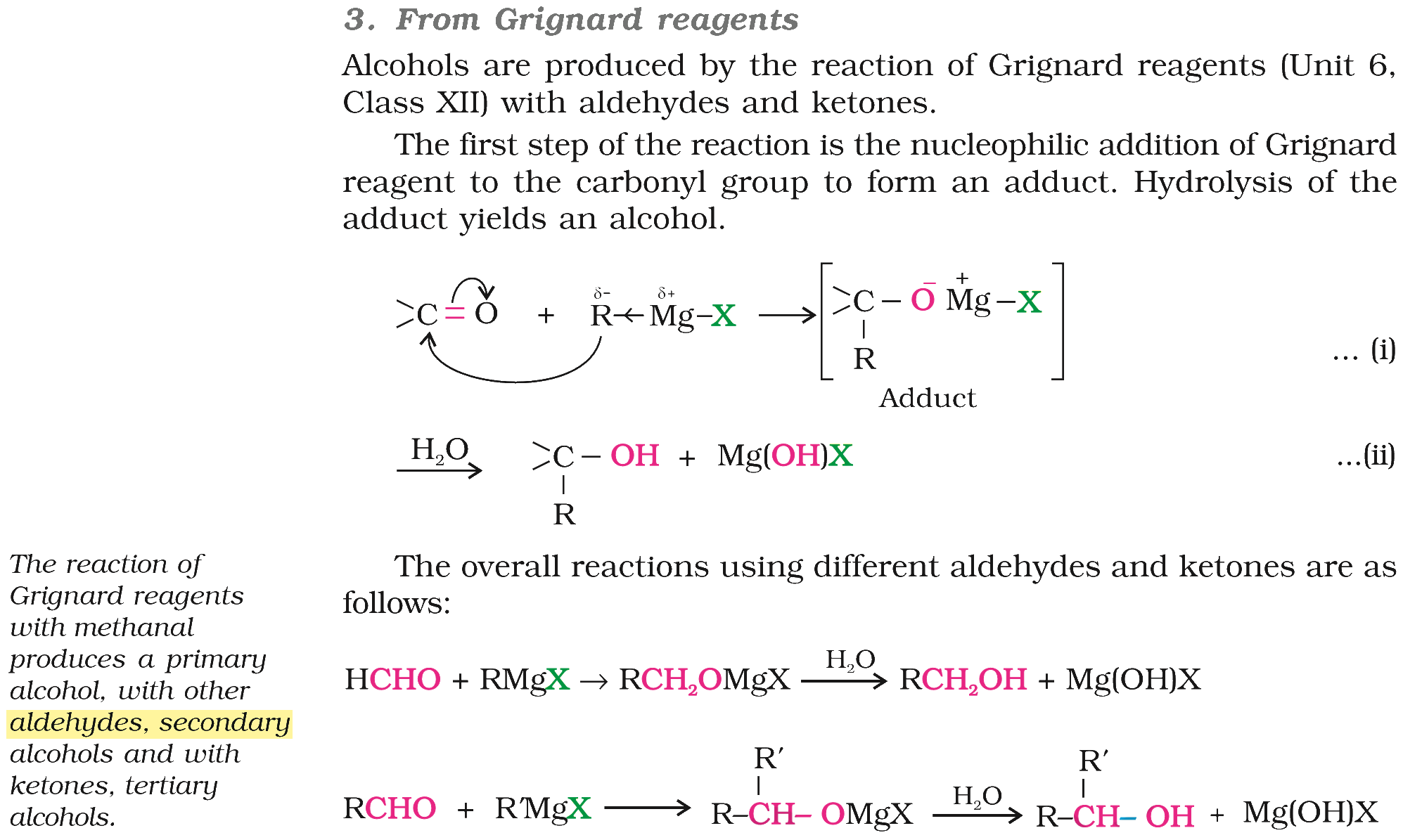
Compound A is formed from propanal and methylmagnesium bromide. A Grignard reagent adds to an aldehyde (other than methanal) to give a secondary alcohol:

    \( \displaystyle \ce{CH3CH2CHO + CH3MgBr} \xrightarrow{\ce{H2O}} \ce{CH3CH2-CH(OH)-CH3} \)

A is butan-2-ol. The carbon bearing –OH is attached to two carbon atoms (a \( \ce{CH3} \) and a \( \ce{C2H5} \) group), and there is no benzene ring. It is also the product of reducing a ketone (butan-2-one), which always gives a 2° alcohol. So A is a secondary aliphatic alcohol.

Why the other options are incorrect

  • Option (1) Primary aliphatic — Incorrect. A primary alcohol such as butan-1-ol would come from methanal with a Grignard reagent, or from reducing an aldehyde, not a ketone.

  • Option (3) Tertiary aliphatic — Incorrect. A tertiary alcohol such as 2-methylpropan-2-ol comes from a ketone and a Grignard reagent; it cannot be made by reducing a ketone.

  • Option (4) Secondary aromatic — Incorrect. A has no benzene ring, so it is not aromatic.

NCERT (2026-27 edition):
From Grignard Reagents
Textbook extract

Advertisement

Practise more on Organic: Alcohols, Phenols and Ethers

Chapter-wise mocks on the real NTA exam screen, with solutions and your rank. Your first mocks are free.

Start free mocks →

Advertisement

Next questions

  1. Match the words in List-I with their synonyms in List-II.List-I (Words)List-II (Synonyms)(A) Phlegmatic(I) Enraged(B) Irate(II) Convincing(…English · Synonyms
  2. Which of the following Indian movie won the Golden Globe Award for Best original Song in 2022?General Aptitude Test · Current Affairs
  3. Who is the bydefault chairperson of GST council?Economics · Indian Economic Development: Liberalisation, Privatisation and Globalisation - An Appraisal
  4. Which of the following monetary tools is used by the RBI to control the inflation?General Aptitude Test · General Knowledge
  5. According to the Vishnudharmottara Purana what does "pramana" in painting involve?1) Aesthetic composition2) Measurements, proportion, and…Fine Arts · The Manuscript Painting Tradition
  6. At what value of MPC is MPC equal to MPS?Economics · Macro Economics: Determination of Income and Employment
  7. Arrange the following modern Indian language families in the descending order of percentage of speakers in India. (A) Sino-Tibetan(B) Austr…Geography · India-People and Economy: Population-Distribution,Density, Growth and Composition
  8. What is the cause behind the convexity of indifference curve to the origin?Economics · Micro Economics: Theory of Consumer behaviour
  9. Who among the following published a set of Ashokan inscriptions in the year 1877?General Aptitude Test · General Knowledge
  10. The specialised centres for making shell objects in the Harappan Civilisation were _________.History · Ancient India: Bricks, Beads and Bones