Based on following paragraph answer the question :
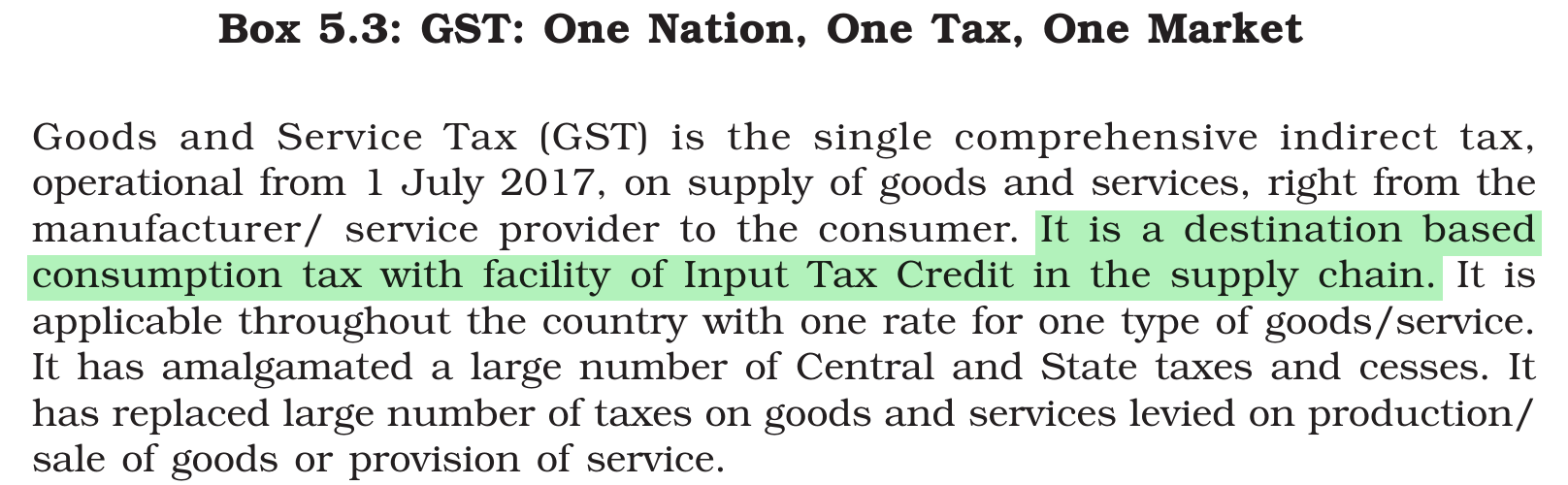
Goods and service tax is the single comprehensive indirect tax implemented on July 1, 2017. It is a destination based tax that has Input Tax Credit in the supply chain. GST is applicable throughout the country.
GST is considered the biggest tax reform since independence. It is implemented through 101st Constitutional Amendment Act.
The aim of GST is to reduce the cost of business operations and cascading effect of various taxes. By implementing GST it is expected that GDP will rise by about 2%. Compliance will also be easier as all tax payment related services are available online through a common portal. GST has expanded the tax base and introduced higher transparency in the taxation system.
GST is destination based tax because :
Answer & explanation
Correct answer: option 2
The correct answer is Option (2) → It has input tax credit system
Note: The given answer is as per the official NTA Answer Key. However, there seems to be a mistake in the answer. GST is called destination based because it is a consumption tax. The tax goes to the place where the good or service is finally consumed. Input tax credit is a separate feature. The NCERT book does not define ‘destination based’, so its standard meaning is used here. So Option (1) → Tax calculated at final consumption should be the correct answer, as explained below.
GST is a destination based consumption tax. It also has the facility of input tax credit in the supply chain. These are two different features.
Option (1) Tax calculated at final consumption — Should be correct. Of the four options, only this one ties the tax to final consumption, which is what makes GST destination based. With input tax credit, the tax paid at all stages adds up to the tax on the final sale value. This tax goes to the State where the good is consumed.
Option (2) It has input tax credit system — The answer given by NTA, but it seems to be incorrect. Input tax credit lets a seller set off the tax paid at the earlier stage against the tax due at the next stage. This stops tax being charged on tax. It is a useful feature of GST, but it does not decide where the tax goes.
Option (3) It is levied on final consumer — Incorrect. GST is charged at every stage of supply, from the manufacturer to the consumer. The final consumer bears the burden of every indirect tax. This is so whether the tax is collected where goods are made or where they are used. So this does not make GST destination based.
Option (4) It is having more transparency — Incorrect. Higher transparency is a result of GST for the tax system as a whole. It has nothing to do with the place where the tax finally goes.
Advice for the exam: In the real exam, mark the answer that is correct as per economic principles and the NCERT book. If NTA’s provisional answer key marks a different option, challenge it during the answer-key challenge window, giving proper reasoning. NTA does revise its key when a challenge is well justified, so a sound challenge can raise your marks.
NCERT (2026-27): Introductory Macroeconomics — Chapter 5: Government Budget and the Economy
|