Which of the following statements are incorrect ?
(A) Circular flow of income does not take place in a closed economy.
(B) Real flow consists of flow of factor services from households to firms.
(C) In a two-sector economy where households do not save, total production is equal to total consumption.
(D) Money flow consists of flow of factor payments from households to firms.
Choose the correct answer from the options given below :
Answer & explanation
Correct answer: option 3
The correct answer is Option (3) → (A) and (D) only
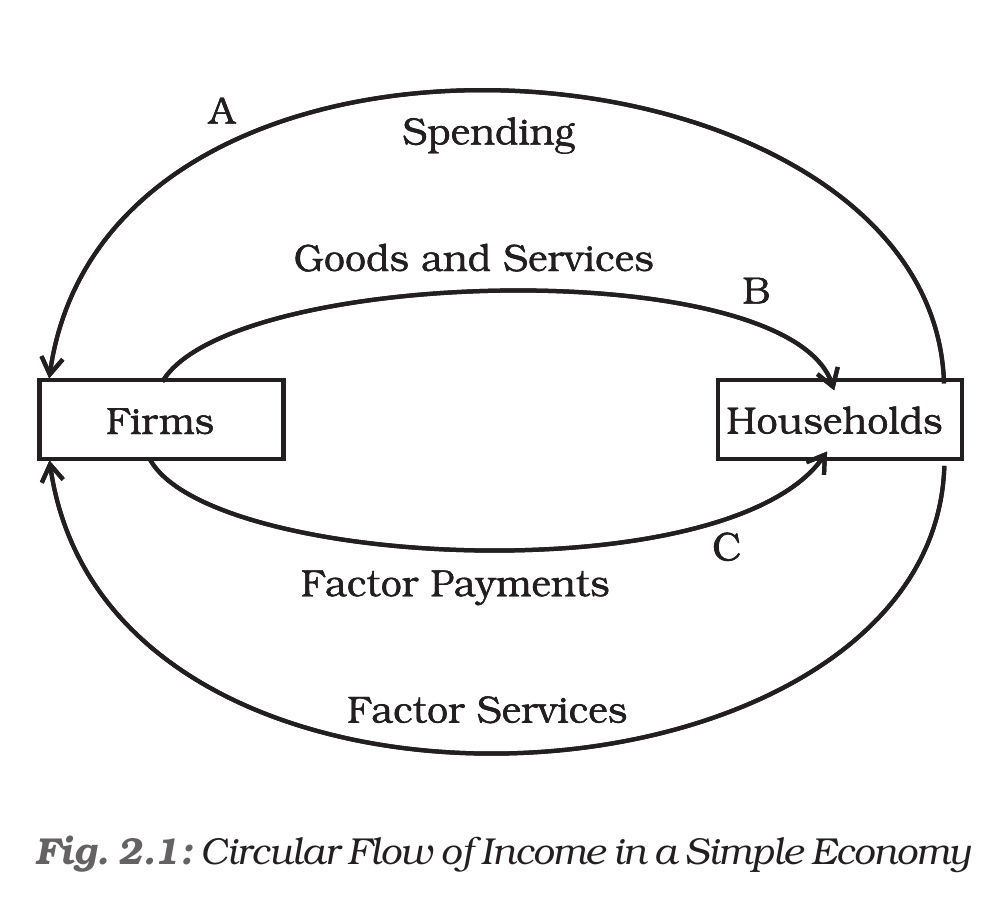
In the circular flow of income, households supply factor services to firms and receive factor payments. They then spend this income on the goods and services produced by the firms.
(A) Circular flow of income does not take place in a closed economy. — Incorrect statement. A closed economy has no foreign trade. Income still goes round between firms and households.
(B) Real flow consists of flow of factor services from households to firms. — Correct statement. Households provide labour, land, capital and entrepreneurship to firms. This movement of services is a real flow.
(C) In a two-sector economy where households do not save, total production is equal to total consumption. — Correct statement. Households spend their whole income on what firms produce, so all the income comes back to the firms.
(D) Money flow consists of flow of factor payments from households to firms. — Incorrect statement. Factor payments are a money flow, and they go from firms to households.
Note: None of the NCERT books (2026-27, 2025-26, 2023-24 or pre-rationalised) uses the terms real flow and money flow. A real flow is a movement of goods or services. A money flow is the payment made for them.
NCERT (2026-27): “2.2 Circular Flow of Income and Methods of Calculating National Income … The description of the economy in the previous section enables us to have a rough idea of how a simple economy – without a government, external trade or any savings – may function.… …In this simplified economy, there is only one way in which the households may dispose off their earnings – by spending their entire income on the goods and services produced by the domestic firms. The other channels of disposing their income are closed: we have assumed that the households do not save, they do not pay taxes to the government – since there is no government, and neither do they buy imported goods since there is no external trade in this simple economy. In other words, factors of production use their remunerations to buy the goods and services which they assisted in producing. The aggregate consumption by the households of the economy is equal to the aggregate expenditure on goods and services produced by the firms in the economy.… …These remunerations will once again be used to buy the goods and services. Hence year after year we can imagine the aggregate income of the economy going through the two sectors, firms and households, in a circular way.… …The two arrows at the bottom of the diagram similarly represent the factors of production market. The lower most arrow going from the households to the firms symbolises the services that the households are rendering to the firms. Using these services the firms are manufacturing the output. The arrow above this, going from the firms to the households, represents the payments made by the firms to the households for the services provided by the latter.…”
|