
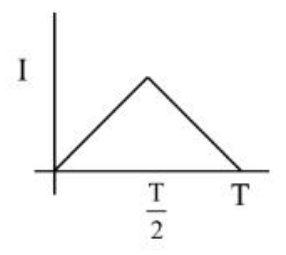
The current I in the inductance is varying with time according to the plot shown in figure. Which of the following is the correct variation of voltage with time in the coil.
Answer & explanation
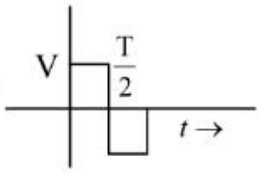
Correct answer: option 4
The correct answer is Option (4)
The voltage across an inductor depends on the rate of change of current, not on the current itself.
\( \displaystyle V = L\,\frac{dI}{dt} \)
So \( V \) is proportional to the slope of the \( I \)-\( t \) graph.
From \( t = 0 \) to \( T/2 \): the current rises along a straight line, so the slope is constant and positive. \( V \) is a constant positive value.
From \( T/2 \) to \( T \): the current falls along a straight line at the same rate, so the slope is constant and negative with the same size. \( V \) is a constant negative value of the same magnitude.
The voltage is therefore a positive rectangle followed by an equal negative rectangle, with the switch at \( T/2 \).
Why the other options are incorrect
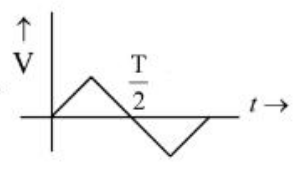
Option (1) — Incorrect. This voltage changes linearly with time, which would need a current changing as \( t^{2} \), not linearly.
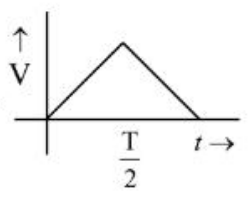
Option (2) — Incorrect. This graph has the same shape as the current; it shows \( V \propto I \), as for a resistor, not \( V \propto dI/dt \).
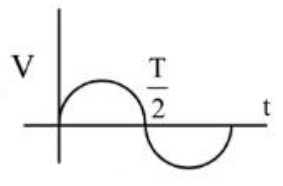
Option (3) — Incorrect. A sinusoidal voltage needs a sinusoidal current; a current made of straight lines gives constant voltage on each part.
Note: A similar question was also asked in CUET (UG) 2023 on 05-06-2023 (Slot 2).
NCERT (2026-27):
Self-Inductance – “… It is also possible that emf is induced in a single isolated coil due to change of flux through the coil by means of varying the current through the same coil. This phenomenon is called self-induction. … When the current is varied, the flux linked with the coil also changes and an emf is induced in the coil. Using Eq. (6.13), the induced emf is given by
\( \displaystyle \varepsilon = -\frac{d(N\Phi_B)}{dt}, \qquad \varepsilon = -L\,\frac{dI}{dt} \qquad (6.14) \)”