Choose the Incorrect statement from the following:
Answer & explanation
Correct answer: option 3
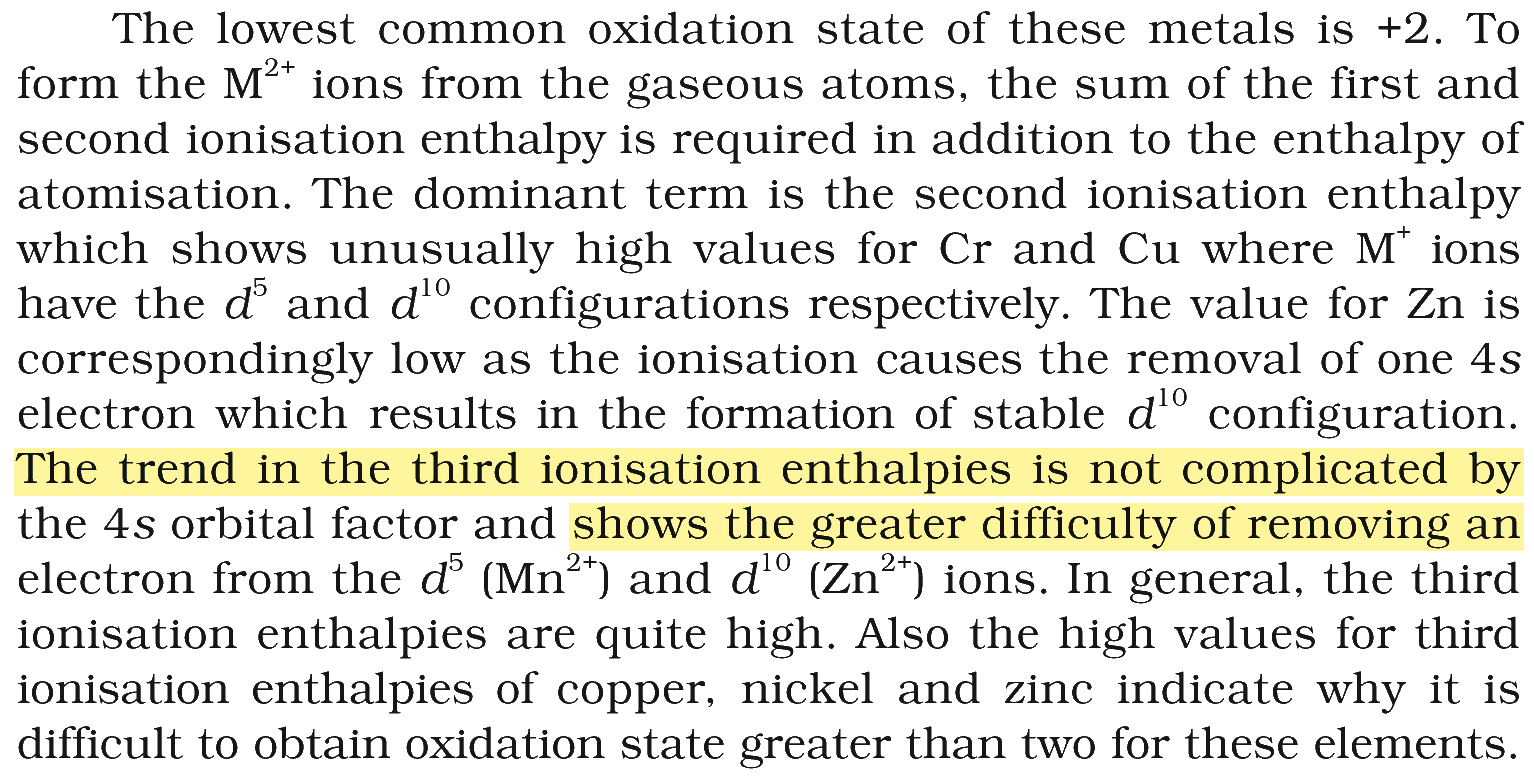
The correct answer is Option (3) → Ionisation enthalpy of Zn2+ is lower than that of Cu2+.
Here, “ionisation enthalpy of Mn+” means the energy needed to remove the next electron from that ion, so for M2+ it is the third ionisation enthalpy of the metal. This value is especially high when the electron has to come out of a stable half-filled d5 or completely filled d10 set. It is comparatively low when losing the electron leaves such a stable set behind.
Option (1) Ionisation enthalpy of Mn+ is lower than that of Cr+. — A correct statement (Mn+ 1509 < Cr+ 1592 kJ mol−1). \( \ce{Cr^{+}} \) is 3d5 and its next electron comes out of a half-filled set; \( \ce{Mn^{+}} \) is 3d54s1 and loses its 4s electron easily.
Option (2) Ionisation enthalpy of Fe2+ is lower than that of Mn2+. — A correct statement (Fe2+ 2957 < Mn2+ 3248 kJ mol−1). \( \ce{Mn^{2+}} \) is the stable half-filled 3d5; \( \ce{Fe^{2+}} \) is 3d6 and becomes 3d5 by losing one electron.
Option (3) Ionisation enthalpy of Zn2+ is lower than that of Cu2+. — The incorrect statement (Zn2+ 3833 > Cu2+ 3554 kJ mol−1). \( \ce{Zn^{2+}} \) is 3d10, so its next electron must come out of a completely filled d set; \( \ce{Cu^{2+}} \) is 3d9.
Option (4) Ionisation enthalpy of V2+ is lower than that of Cr2+. — A correct statement (V2+ 2828 < Cr2+ 2987 kJ mol−1). \( \ce{V^{2+}} \) is 3d3 and \( \ce{Cr^{2+}} \) is 3d4; Cr has one more proton and holds its electrons more strongly.
NCERT (2026-27 edition):
Ionisation Enthalpies – …