
Friedel-Crafts reaction is an example of
Answer & explanation
Correct answer: option 3
The correct answer is Option (3) → electrophilic substitution reaction.
The benzene ring is rich in π electrons, so its typical reactions are electrophilic substitution: an electron-poor species (E+) attacks the ring and replaces a hydrogen atom, and the aromatic ring is kept.
In a Friedel–Crafts reaction, anhydrous \( \ce{AlCl3} \) pulls the chlorine away from an alkyl halide or acyl chloride and produces the electrophile, for example the methyl carbocation:
\( \displaystyle \ce{CH3Cl + AlCl3 -> CH3^+ + AlCl4^-} \)
The electrophile attacks the ring, and the ring then loses \( \ce{H+} \) to get back its aromatic sextet. Friedel–Crafts alkylation and acylation of benzene:
\( \displaystyle \ce{C6H6 + CH3Cl} \xrightarrow{\text{anhyd. }\ce{AlCl3}} \ce{C6H5CH3 + HCl} \)
\( \displaystyle \ce{C6H6 + CH3COCl} \xrightarrow{\text{anhyd. }\ce{AlCl3}} \ce{C6H5COCH3 + HCl} \)
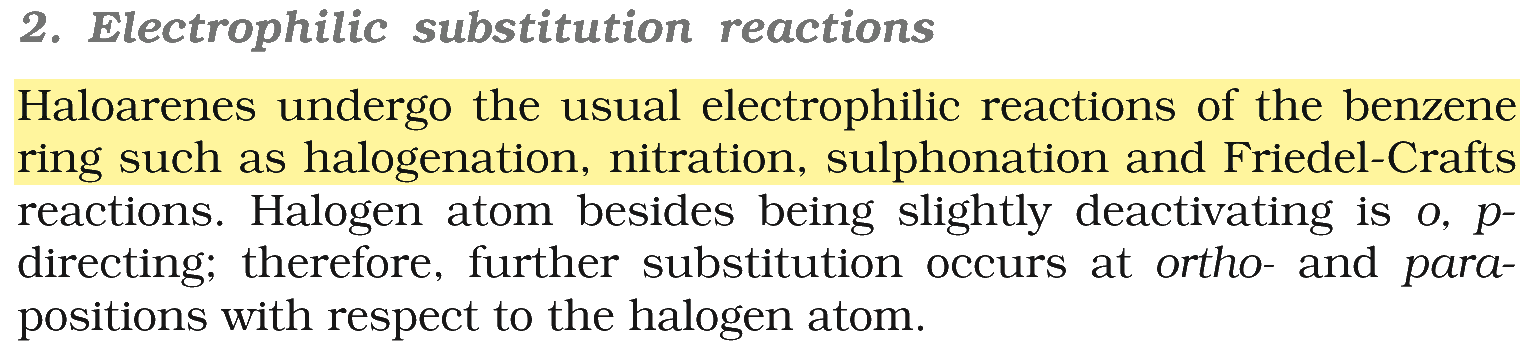
Haloarenes react in the same way; chlorobenzene gives 2-chlorotoluene (minor) and 4-chlorotoluene (major) with \( \ce{CH3Cl} \). All are examples of electrophilic substitution.
Why the other options are incorrect
Option (1) electrophilic addition reaction. — Incorrect. Electrophilic addition is typical of alkenes. The aromatic ring does not add reagents here, as that would destroy its stability.
Option (2) nucleophilic addition reaction. — Incorrect. This is the typical reaction of the C=O group of aldehydes and ketones, not of an aromatic ring.
Option (4) nucleophilic substitution reaction. — Incorrect. Here a nucleophile would replace a leaving group, as in alkyl halides. In a Friedel–Crafts reaction the attacking species is an electrophile.
NCERT (2026-27 edition):
Electrophilic Substitution Reactions
Note: The same/similar question has been asked in different years by NTA as per the details given below:
| 2026 | 2025 | 2024 | 2023 | 2022 |
|---|---|---|---|---|
| 14-05 S2 11-05 S1 | – | – | – | – |