CUETMOCK
  • Pricing
  • Mentors
Log inStart freeStart free mocks→

First test, then trust

Try a free CUET mock test.

Join 5,00,000+ students who rehearsed exam day on the exact NTA screen before sitting CUET. On the web and on Android.

Start free mocks →Get the Android app
CUETMOCK

India's #1 CUET Mock Test Platform. Original NCERT-based questions on the exact NTA exam screen — trusted by 5,00,000+ students since CUET 2022.

Get it onGoogle PlayScan to download the CUETMOCK app

Mock tests

  • CUET mock test series
  • Browse all papers
  • Commerce mocks
  • Humanities (Arts) mocks
  • Science mocks
  • Languages & GAT mocks
  • Free practice questions
  • Pricing

Resources

  • CUET exam guide
  • CUET syllabus
  • Universities accepting CUET
  • Expert blogs
  • News & notifications
  • Webinars & counselling
  • CUET score calculator
  • How we estimate your rank
  • FAQs

Company

  • About us
  • Our leadership & team
  • Our toppers
  • Mentors
  • For schools
  • Contact us
  • Terms
  • Privacy
  • Refund policy

Talk to us

+91 7696 6630 56info@cuetmock.comWhatsApp us

Our other platforms

  • JEE Mock — For IIT-JEE aspirants
  • NEET Mock — For NEET aspirants

Newsletter

Exam updates, study material and offers — no spam.

© 2026 NYC Ventures Pvt. Ltd.

701-702, Royal Business Park, Zirakpur, Punjab - 140603

  • Terms of use
  • Privacy policy
  • Refund policy
  • Contact us

iCUETMOCK is an independent preparation platform, not affiliated with the National Testing Agency (NTA). Always check exam details on the official NTA website.

  • Home
  • Mock tests
  • CUET guide
  • Pricing
  • Log in
Home/Practice questions/History
HistoryAncient India: Kinship, Caste and Class

Arrange the following major textual traditions in a chronological ord…

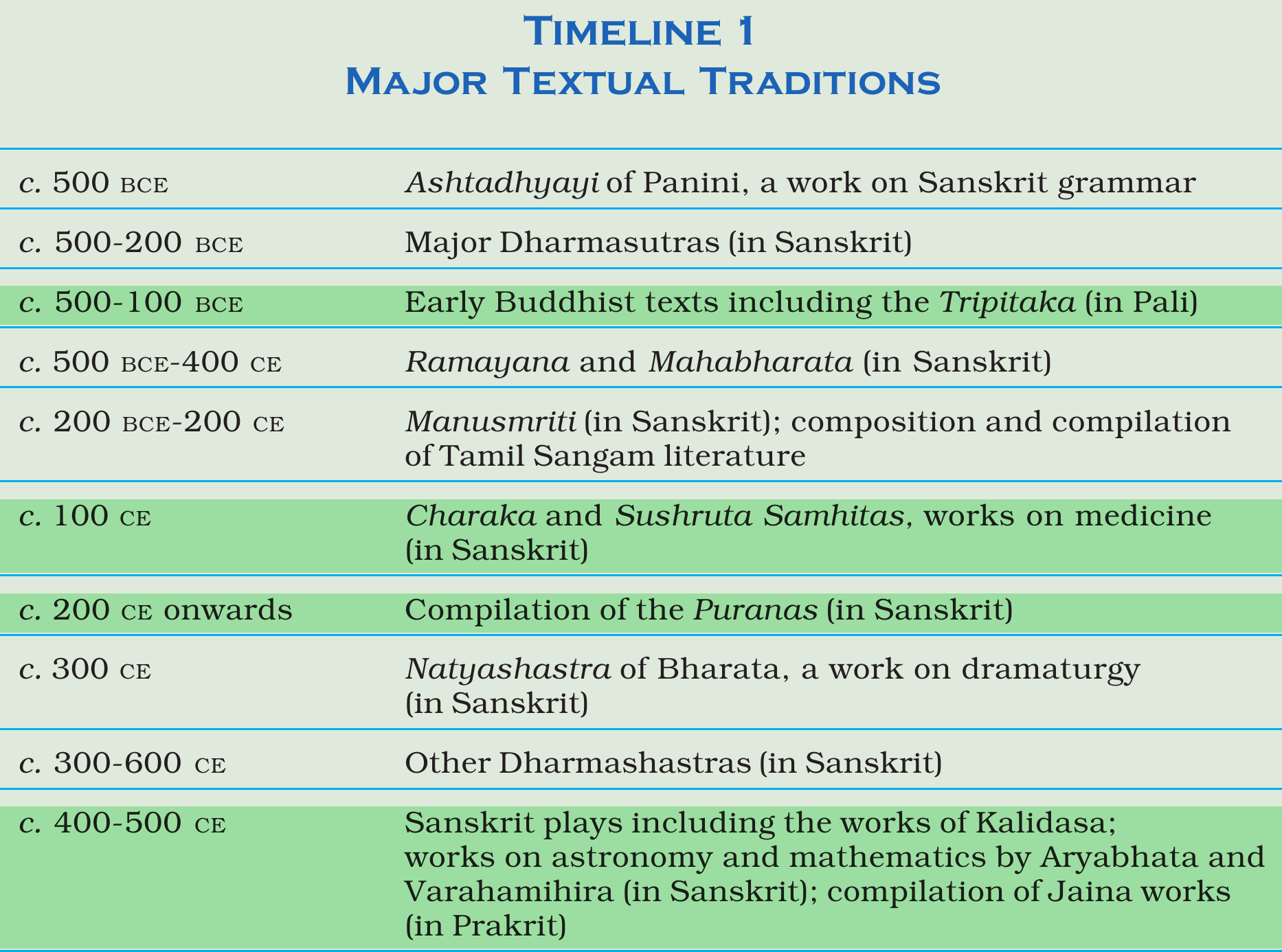
Arrange the following major textual traditions in a chronological order:

(A) Works of Kalidasa

(B) Compilation of Puranas

(C) Early Buddhist texts including the Tripitaka

(D) Charaka and Sushruta Samhitas

Choose the correct answer from the options given below:

Answer & explanation+

Correct answer: option 4

The correct answer is Option (4) → (C), (D), (B), (A)

(C) Early Buddhist texts including the Tripitaka — c. 500-100 BCE. These texts were in Pali.

(D) Charaka and Sushruta Samhitas — c. 100 CE. These were works on medicine, written in Sanskrit.

(B) Compilation of Puranas — c. 200 CE onwards, in Sanskrit.

(A) Works of Kalidasa — c. 400-500 CE. Kalidasa’s Sanskrit plays belong to the same period as the works on astronomy and mathematics by Aryabhata and Varahamihira.


NCERT: Themes in Indian History Part I — Chapter 3: Kinship, Caste and Class (2025-26)

NCERT extract

Advertisement

Practise more on Ancient India: Kinship, Caste and Class

Chapter-wise mocks on the real NTA exam screen, with solutions and your rank. Your first mocks are free.

Start free mocks →

Advertisement

Next questions

  1. Market demand curve for labour is _____.Economics · Micro Economics: Market Equilibrium
  2. Vijayanagara or "City of Victory" was founded in the 14th century. In 1565 the city was sacked and subsequently deserted, and it fell into…History · Medieval India: An Imperial Capital: Vijayanagara
  3. What is 'production' under tertiary activities?Geography · Fundamentals of Human Geography: Tertiary and Quaternary Activities
  4. The "Jakham Dam" is located in which of the following state?General Aptitude Test · General Knowledge
  5. The concept of 'mens rea' evolved in which country?Legal Studies · Topics of Law
  6. Which of the following is the fear of taking medicines?English · Phobia
  7. A dealer sells two machines at the rate of Rs. 15000 per machine. On one he earns a profit of 20 percent and on the other he loses 40 perce…General Aptitude Test · Numerical Ability
  8. Two cards are drawn simultaneously at random from a well shuffled pack of 52 Cards. Let X be the random variable which denotes number of ki…Maths. Section A · Probability
  9. What is the price elasticity of supply at point S in the given figure?Economics · Micro Economics: Theory of Firms under Perfect Competition
  10. If cosec~ θ+cot θ=p, then the value of (p^2-1)/(p^2+1) is:General Aptitude Test · Quantitative Reasoning